
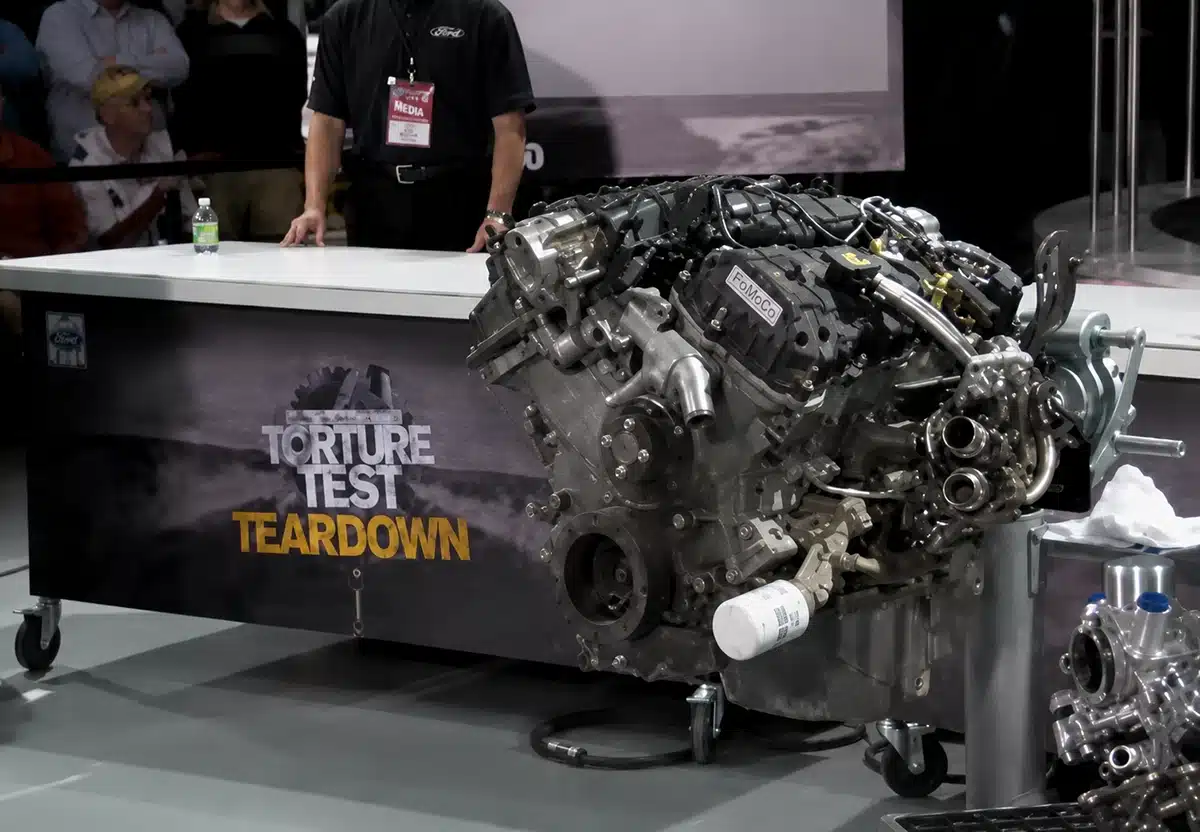
When Ford introduced the 3.5L EcoBoost V6 in the 2011 F-150, many truck buyers questioned whether a twin-turbo V6 could really replace a V8 in a full-size pickup. Rather than simply claim it would last, Ford publicly abused one production engine, then tore it apart at the Detroit Auto Show for everyone to inspect.
Looking back through the grainy footage preserved on the YouTube from a Ford dealership, along with Ford’s original promotional videos on various YouTube channels and media coverage from the time, it’s easy to forget just how remarkable this event was then and still is today. Automakers simply don’t do this type of thing.
Said one spectator in the 2011 press release: “Ford has a lot of guts to take this apart in public, especially after all that has been done to this engine.”
Ford Had Something to Prove
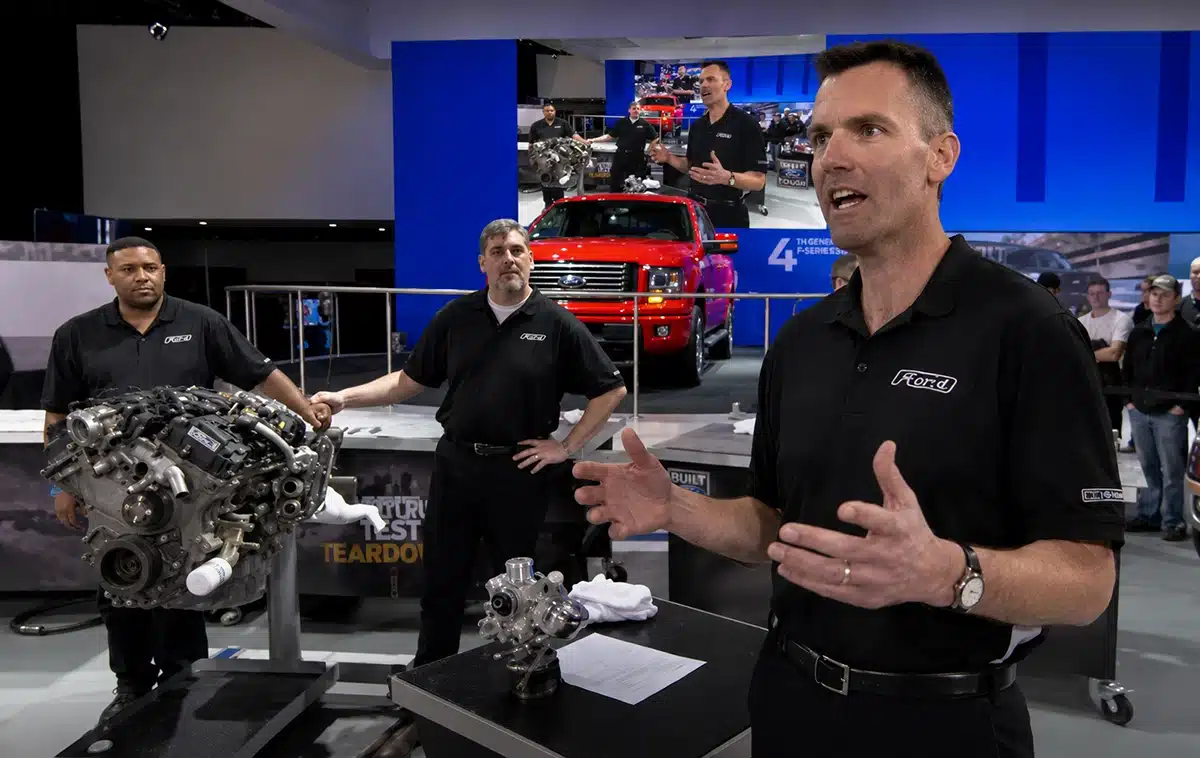
Ford called its durability program “Beat to Hell and Back,” and it was designed to convince skeptical truck buyers that the EcoBoost could survive years of hard work.
Engineers randomly selected a production 3.5L EcoBoost engine and began by simulating 150,000 miles on a dynamometer. Those tests replicated years of towing, steep grades, extreme temperatures and full-throttle operation in just a few weeks.
The same engine was then installed in an F-150 that hauled more than 55 tons of timber, completed a 24-hour towing test at Homestead-Miami Speedway with an 11,300-pound trailer, and survived the brutal Baja 1000 desert race.
After more than 165,000 miles of simulated and real-world abuse, Ford shipped the exact same engine to the Detroit Auto Show instead of retiring it. Engineers then disassembled it live in front of a live audience, measuring critical components while explaining exactly what they found.
The Teardown Proved the EcoBoost Was Tough
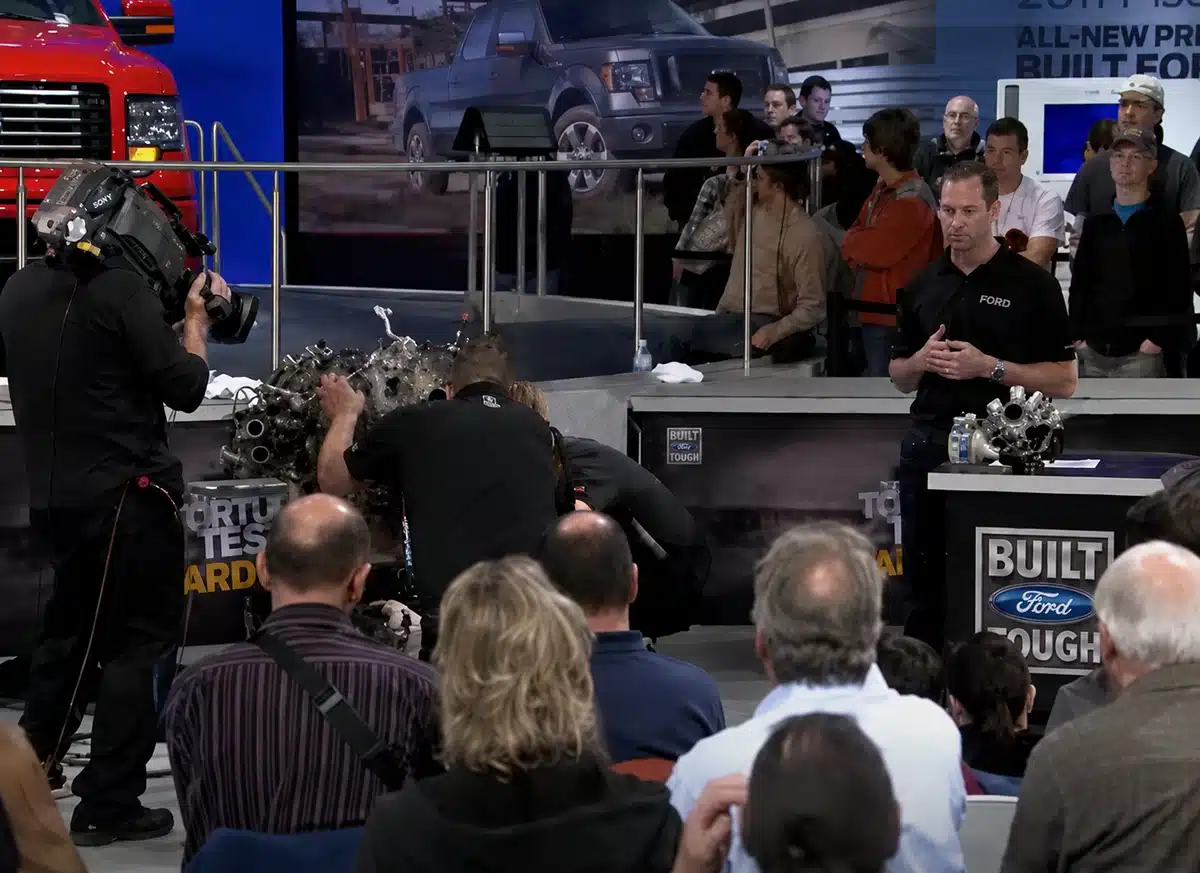
Ford’s engineers weren’t interested in simply saying the engine survived. They wanted to prove it with measurements.
Before the teardown even began, the engine was returned to the dynamometer. Despite everything it had endured, it produced essentially the same horsepower and torque as it had before the testing started.
Once the engine was apart, the results were equally impressive. Crankshaft endplay remained within new engine specifications, piston skirt coatings showed very little wear, piston rings still moved freely, and the cylinder walls retained their original crosshatch pattern, indicating minimal wear and good oil control.
Engineers also inspected the turbochargers, checked cylinder leakdown, and found only minimal carbon deposits inside the engine. Their conclusion was bold. Based on the inspection, they believed the engine could realistically deliver another 150,000 miles of service.
“Given the intense engineering and research and the severity of the durability tests we run that go into all Ford engines, I’m not at all surprised how good this engine looked,” said Ford powertrain technician Chris Rahill in the 2011 press release. “Everything was within manufacturing specification. Nothing was out of the norm.”
Looking back today, few critics argue the EcoBoost’s block, crankshaft, connecting rods or pistons were weak. Ford largely proved what it set out to prove. The foundation of the engine was exceptionally durable. However, critics are still questioning a lot of the same things, the test proved weren’t an issue.
Fifteen Years of Ownership Revealed More
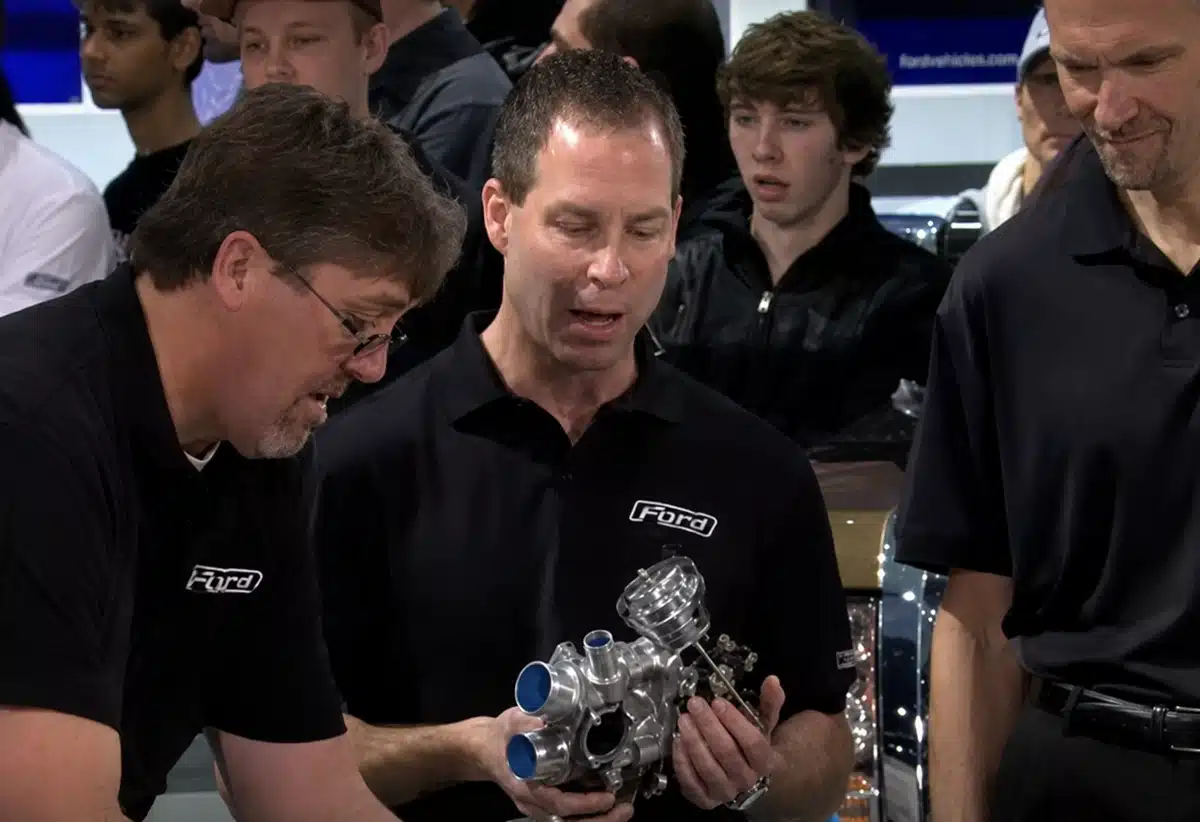
The famous teardown answered one question, but time passed and people forgot about the test.
Several items that were addressed and answered in that test are still amongst the most hotly debated topics on truck forums today.
For example, carbon buildup with regards to direct injection.The first-generation 3.5L EcoBoost relied solely on direct fuel injection. Critics point out this allows deposits to accumulate on the intake valves over time because fuel never washed across them. Ford addressed this concern in the torture test by showing how little carbon buildup their was on the engine.
They later added port fuel injection to the second-generation engine.
Speaking with engineers from all manufactures on this topic over the years, they all point out that adding port injection can help with carbon buildup, but that’s not the point of adding it to the engine. They add it to meet other targets.
Carbon buildup is really an internet concern and was a big one, back in the day, with shops offering walnut washing services to clean up that “gunk in your engine robbing you of MPG!” Good luck finding many of those shops today.
Oil changes also became one of the hottest debates among enthusiasts.
When the EcoBoost launched, Ford promoted its Intelligent Oil Life Monitor, which calculated oil change intervals based on operating conditions instead of a fixed mileage schedule. Under normal highway driving, that could mean intervals approaching 10,000 miles, while towing, frequent short trips or severe service would shorten the recommendation considerably.
This created a storm of controversy and it still does today. The 10k mile oil changes are at the heart of every engine failure out there. It is literally one of the first comments whenever an engine fails is a question on oil change intervals. It must be the oil is the first thought.
Many owners simply refused to believe 10k mile oil changes and many dealerships feed into that fear as well. Rather than relying entirely on the oil life monitor, they began changing oil every 5,000 miles or sooner, believing fresh oil was inexpensive insurance for a turbocharged, direct-injected engine expected to last well beyond 200,000 miles.
What’s interesting, from my perspective, is you have situations like the 2022 3.4-liter turbocharged V6, an engine that is similar to the Ford EcoBoost, from Toyota that was failing and no matter how often people changed their oil, the engine failed. I heard people change oil every 1,000 miles. A part is a part and if it fails, it fails became the understanding.
Turbocharger reliability also turned out differently than many expected. In 2011 and still today, critics predicted widespread turbo failures. Instead, most EcoBoost turbochargers have proven durable when properly maintained, even if failures do occur from time to time they aren’t nearly as widespread as people would have you believe. The majority of trucks sold today have turbocharged engines and we just don’t see the volume of reports of turbochargers, themselves, failing matching the number of trucks sold.
Long-term ownership also revealed timing chain concerns on some early EcoBoost engines and cam phaser issues on many 2017 through early 2020 models. Those discussions emerged only after years of customer ownership and weren’t something Ford’s accelerated durability testing was designed to predict.
Ford updated their EcoBoost at various intervals to address those concerns and now you’ll see an occasional comment about “have they fixed the cam phaser issue, yet! LOL.” The answer is yes. Yes, they have.
Ford Was Mostly Right

Fifteen years later, Ford’s famous teardown remains one of the automotive industry’s boldest engineering demonstrations.
It proved the EcoBoost’s core engine design was built to handle serious abuse. The discussions that followed weren’t about cracked engine blocks or weak internals. Instead, they centered on maintenance practices, oil change intervals, carbon buildup, timing components and getting the most life out of an increasingly sophisticated engine.
Ford took plenty of criticism in 2011 for asking truck buyers to trust a twin-turbo V6 instead of a V8. Fifteen years later, that gamble looks far less controversial. The EcoBoost didn’t prove every skeptic wrong, but it proved the future of full-size truck engines would look very different than anyone expected.












3 replies
Loading new replies...
Administrator
New member
Active member
Moderator
Join the full discussion at the Forum Pickuptrucktalk →