

Every week, I get emails from people asking a version of the same question: Which full-size truck should I buy?
The honest answer is always that it depends. Some people tow every weekend. Some rarely use the bed. Some care about a V8 exhaust note, while others care more about fuel economy, safety or having enough electrical power to run a camper.
Still, people love rankings, and I understand why. Truck shopping has become incredibly complicated. Prices have climbed, packages do not always make sense and two trucks wearing the same badge can have completely different engines, towing ratings and equipment.
So, I decided to build the truck I would personally buy from each full-size truck brand and rank all five. I used each automaker’s online build-and-price tool, carefully selecting the trim, powertrain, packages and individual options I would actually purchase.
I have personally owned several of these trucks and driven all of them numerous times during my 15 years covering the automotive industry. I have towed with them, driven them at night and through snowstorms, taken them hunting and spent thousands of miles behind the wheel on long-distance trips. I know these trucks beyond their spec sheets.
This is not a claim that one truck is universally the best. It is my personal shopping list based on how I use a truck, what I need it to do and what I would be willing to spend.
The Ground Rules
To make the comparison as fair as possible, every truck is a crew cab with four-wheel drive and the shortest available bed, generally around 5 feet, 7 inches. This is the configuration that works best for my family and work needs. It is also one of the most popular configurations and should be relatively easy to find on dealership lots.
My target price is approximately $65,000, including destination but before taxes, registration and dealer fees. A few builds land slightly above that target because of package requirements, but none is allowed to escape into luxury-truck pricing.
My camper weighs about 5,200 pounds dry and approximately 7,000 pounds fully loaded with water, supplies and gear. Most of the time, campers are towed with the water and waste tanks empty, so the real towing load typically falls between those figures.
How I Scored the Trucks

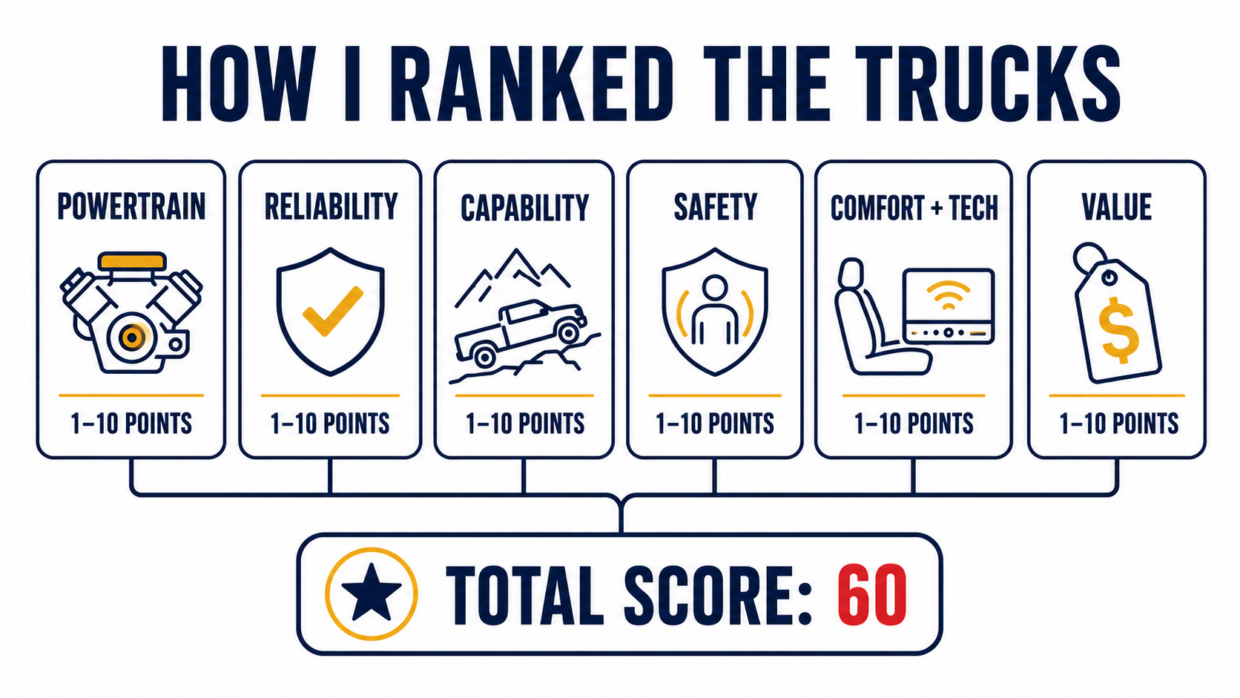
Each truck receives 1 to 10 points in six categories, for a maximum score of 60.
Powertrain
This includes acceleration, drivability, fuel economy, transmission behavior and how the engine performs while towing. Fuel economy belongs here because it is inseparable from the powertrain choice.
Reliability Confidence
This score comes from Pickup Truck + SUV Talk’s Reliability Center, known-problems reporting, owner experiences, recalls and the severity of the problems involved. A failed screen matters, but a failed engine matters much more.
Capability
I considered the actual configuration, not the manufacturer’s maximum advertised number. This includes towing equipment, trailer brake controller, axle ratio, four-wheel-drive hardware, bed utility and whether the truck comfortably handles my camper.
Safety
The primary evidence is Insurance Institute for Highway Safety testing. Available active-safety and trailering-assistance features also matter, especially when manufacturers hide them inside expensive option packages.
Comfort and Technology
This covers ride quality, seat comfort, cabin layout, infotainment, cameras, storage and useful features I would notice during everyday ownership.
Value
Value is not simply the lowest price. It measures what I receive for the money, whether packages force me to buy unwanted equipment and how closely I can configure the truck I actually want.
Final Scores
Here is how each truck scored.
| Rank | Truck | Powertrain | Reliability | Capability | Safety | Comfort + Tech | Value | Total |
|---|---|---|---|---|---|---|---|---|
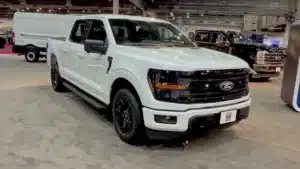
| 1 | Ford F-150 XLT PowerBoost | 9 | 7 | 9 | 6 | 9 | 9 | 49/60 |
| 2 | Ram 1500 Big Horn Hurricane | 9 | 7 | 8 | 7 | 9 | 8 | 48/60 |
| 3 | GMC Sierra 1500 SLE Duramax | 10 | 6 | 10 | 4 | 6 | 10 | 46/60 |
| 4 | Toyota Tundra Limited TRD Off-Road | 8 | 5 | 8 | 9 | 8 | 6 | 44/60 |
| 5 | Chevrolet Silverado 1500 RST Duramax | 10 | 6 | 10 | 4 | 6 | 7 | 43/60 |
The GMC Elevation alternative scores 44 out of 60. It has the same mechanical scores as the SLE, but its Value score drops from 10 to 8 because its price climbs to $66,105 primarily for appearance, bucket seats and the center-console layout.
No. 5: 2026 Chevrolet Silverado 1500 RST Duramax, 43/60
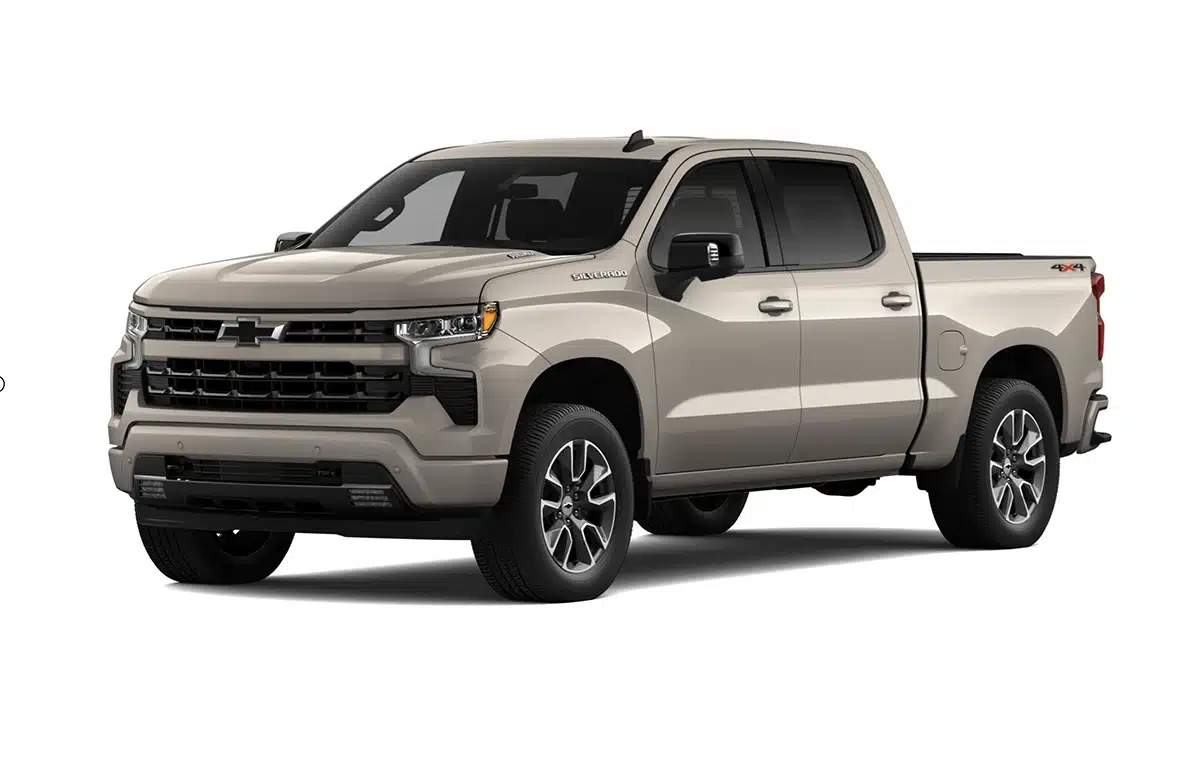
My Build
- RST Crew Cab with short bed and four-wheel drive
- 3.0-liter Duramax diesel
- 10-speed automatic
- 3.73 rear axle and Max Trailering Package
- RST All Star Premium Package
- White Sands exterior
- Total: $65,855 including destination and package discount
I chose RST rather than LTZ to create room for options around the $65,000 target. Then GM’s package structure made that difficult anyway.
The engine choice is easy. I would buy the 3.0-liter Duramax. The TurboMax four-cylinder is fine for daily drivers who do not tow or haul frequently, but the diesel is quieter, smoother, substantially more efficient and exceptionally relaxed under load.
My long-term Silverado consistently returned fuel economy in the mid-20s and did reach 30 mpg on longer highway trips. During the camper comparison, the Duramax delivered approximately 10 to 12 mpg while towing and required the least effort from the driver. Its engine braking, transmission-temperature control and broad torque delivery make it the best half-ton towing powertrain in this group.
The 5.3-liter V8 is familiar but not especially powerful or efficient. Lifter concerns are probably exaggerated online, but they still exist. The 6.2-liter V8 is available on a four-wheel-drive RST and offers 420 horsepower and 460 pound-feet. It is the genuine gas-versus-diesel decision, but it requires premium fuel to deliver its advertised performance. I would still choose the Duramax for its 495 pound-feet of torque and much better fuel economy.
I added the 3.73 axle and Max Trailering Package. This configuration can tow roughly 13,000 pounds, which is far beyond what my camper requires. The trade-off is a single-speed transfer case without four-low because Max Trailering conflicts with the Z71 equipment. For me, maximizing towing capability is more useful than low range I would rarely use.
The biggest frustration is GM’s packaging. To get adaptive cruise control, trailering cameras, rear cross-traffic braking, parking sensors and other safety features, the configurator pushes me into packages containing leather seats, wheelhouse liners, a spray-in bedliner, premium audio and 20-inch wheels.
Explain why adaptive cruise control is packaged with rear wheelhouse liners.
The Duramax is excellent, GM’s camera system is outstanding and the refreshed interior remains easy to use. Unfortunately, the seats are terrible. This was not limited to an older truck or one unusual test vehicle. The seats in my 2023 Silverado were uncomfortable, and poor seat comfort has been a consistent complaint across the current GM full-size truck lineup.
Seat comfort is something you experience every mile, whether the truck is towing or sitting in traffic. If that is a major concern, I would wait to see what GM changes with the redesigned 2027 model. The Comfort and Technology score drops accordingly. The Value score also suffers because the package structure pushes an RST slightly beyond the target price and makes buyers pay for unrelated equipment.
Safety is the largest scoring penalty. The 2026 Silverado Crew Cab received Acceptable scores in pedestrian front-crash prevention and side impact, Marginal in the small-overlap front test, and Poor in the moderate-overlap front and headlight tests. That result is difficult to overlook in a family truck.
Reliability depends heavily on engine choice. The 6.2-liter recall involved the possibility of complete engine failure, while some 5.3-liter engines have experienced lifter problems. The Duramax avoids those specific failures but has its own reported thrust-bearing, coolant-control-valve and long-term service concerns. Choosing the diesel reduces the risk, but it does not erase GM’s overall record.
Related post: 2021-2026 Chevy Silverado 1500 Known Problems: Engine Failures, Lifters, Transmission Issues and Recalls
Chevrolet Score
- Powertrain: 10
- Reliability Confidence: 6
- Capability: 10
- Safety: 4
- Comfort and Technology: 6
- Value: 7
- Total: 43 out of 60
No. 4: 2026 Toyota Tundra Limited TRD Off-Road, 44/60
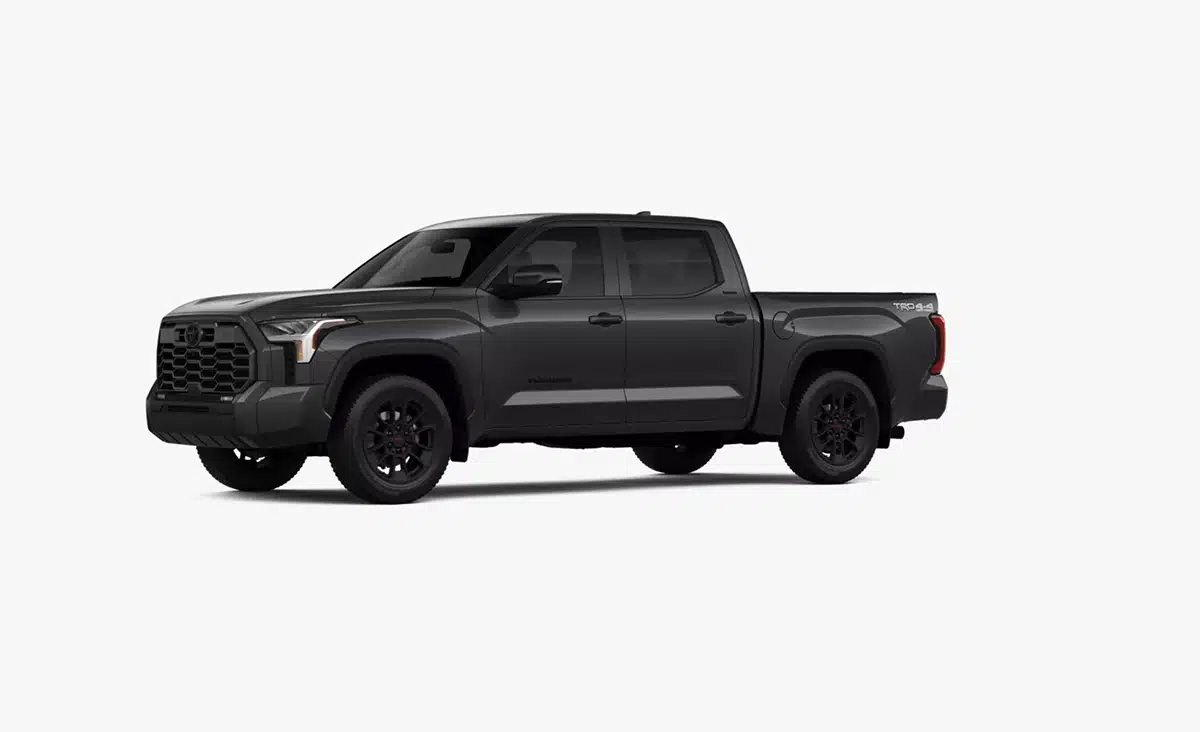
My Build
- Limited CrewMax with 5.5-foot bed and four-wheel drive
- Standard i-FORCE twin-turbo V6
- TRD Off-Road Package
- Panoramic roof
- Magnetic Gray Metallic
- Total: $64,985 including destination
I have essentially owned this truck before. My 2022 Tundra was a Limited CrewMax with the short bed, four-wheel drive and the TRD Off-Road Package. That ownership experience makes this one of the easiest trucks for me to evaluate and one of the hardest to rank.
I considered dropping to the SR5. One reason I previously chose the Limited was access to comfort features such as heated seats and a heated steering wheel. For 2026, heated and ventilated front seats are standard on the Limited, while the heated steering wheel is a separate option. The problem is that neither feature worked particularly well in my 2022 truck.
Wearing gloves and saving money with an SR5 sounded reasonable until I started using Toyota’s configurator. Once I added the TRD Off-Road equipment and the packages required to get closer to the features I wanted, the SR5 climbed to approximately $63,000. At that point, it was close enough to the Limited that stepping up to the better-equipped trim made more sense.
The panoramic roof is one luxury item I would keep. It brightens the cabin during Nebraska’s dark winter days, and this build leaves just enough room under my target budget to include it.
The TRD Off-Road Package also stays. This is not just an appearance package. It adds Bilstein shocks, an electronically locking rear differential, skid protection, all-terrain tires, Multi-Terrain Select, Crawl Control and useful camera technology. It also adds the color-keyed grille surround, which removes the Tundra’s mustache look and makes the truck look much better – a much-needed appearance upgrade.
I would choose the standard i-FORCE V6. Its 389 horsepower and 479 pound-feet of torque are more than enough for daily driving and towing my camper. In my towing test, the Tundra was quiet, stable and confident. It returned 11.6 mpg on the 50-mile loop, the best gasoline result in that comparison.
The hybrid increases output to 437 horsepower and 583 pound-feet, but the 2026 system does not provide a meaningful fuel-economy improvement or the type of high-output onboard power that makes Ford’s hybrid useful. Toyota has confirmed a 2.4-kW inverter for 2027 i-FORCE MAX models. If I wanted the hybrid, I would wait.
Safety is the Tundra’s greatest strength. It was the only conventional pickup to earn a 2026 IIHS Top Safety Pick designation. It scored Good in the three crashworthiness tests used for the award.
Reliability confidence is the problem. Toyota has replaced engines after machining debris was linked to failures in certain 2022-2024 non-hybrid trucks. The recall population expanded, and later documents raised concerns involving the No. 1 main bearing. My own Tundra also experienced a cracked seat, wind noise, weatherstripping problems and frustrating infotainment behavior. Newer results are improving, but these trucks need more time and mileage.
Related post: 2024-2025 Toyota Tundra Known Problems – Engine, Throttle Lag, Other Issues
There is another Toyota-specific drawback. You cannot really build and special-order the exact truck you want. Toyota determines which configurations to produce and allocates them to dealers. Its configurator identifies the truck I hope to find, not necessarily one I can order.
I may have to compromise on color, accept unwanted distribution-installed accessories or wait for a similar truck to become available. With the other brands, I am building the truck I would order. With Toyota, I am building the truck I hope I can find.
Toyota Score
- Powertrain: 8
- Reliability Confidence: 5
- Capability: 8
- Safety: 9
- Comfort and Technology: 8
- Value: 6
- Total: 44 out of 60
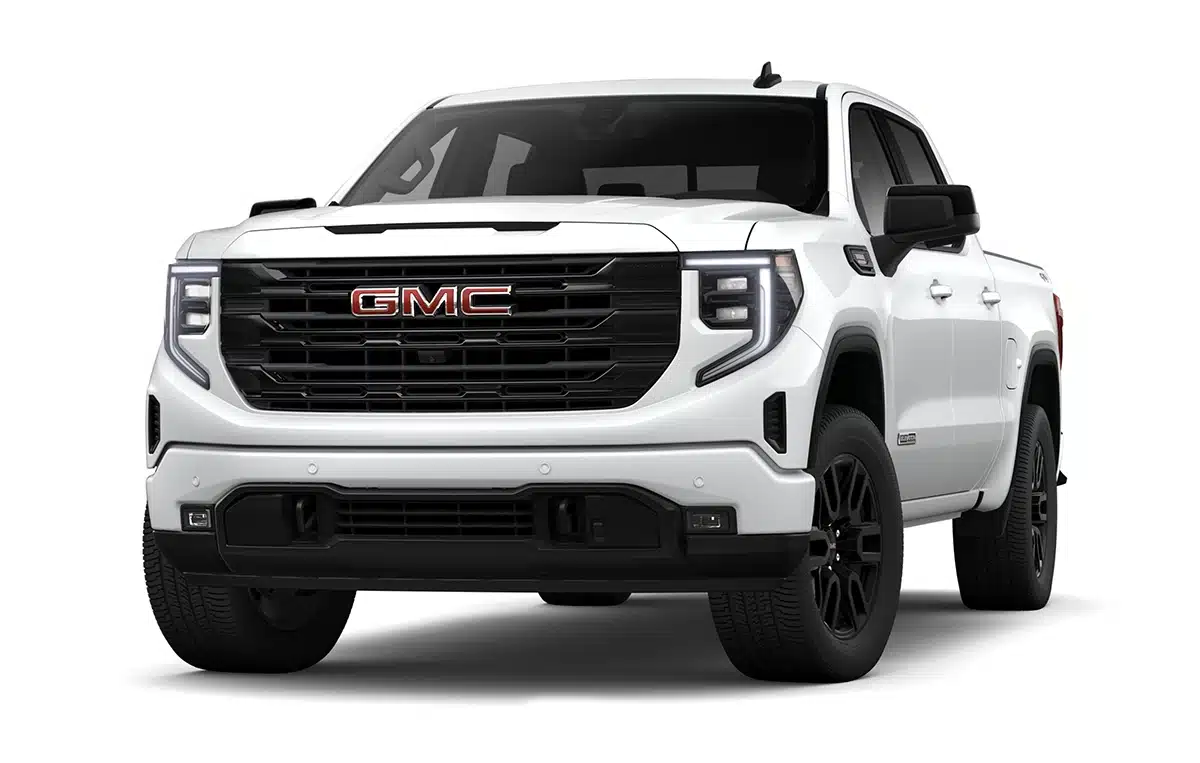
No. 3: 2026 GMC Sierra 1500 SLE Duramax, 46/60
My Build
- SLE Crew Cab with short bed and four-wheel drive
- 3.0-liter Duramax diesel
- Max Trailering Package
- Sierra Safety Plus Package
- Preferred Package
- MultiPro Tailgate
- 18-inch wheels and heated cloth bench seat
- Total: $63,650 including destination
GMC shares most of the Chevrolet’s engineering, which means it also receives the best powertrain in this comparison. The Duramax is efficient, quiet and exceptionally easy to tow. The Max Trailering Package gives this truck considerably more capacity than my camper needs, while GMC’s camera views and trailering software reduce the stress of hitching and towing.
What surprised me was the value of the SLE. It stays below the target price while retaining the diesel engine, Max Trailering Package, safety technology, heated seats, heated steering wheel, large infotainment display, and MultiPro Tailgate.
I also prefer its 18-inch wheels for a family and towing truck. They provide more tire sidewall, should ride better and will generally cost less to replace than the Elevation’s 20-inch wheels. The 40/20/40 bench and column shifter provide a traditional truck layout and the possibility of carrying six people.
The cabin architecture is not the newest in the segment, and GM continues to lock desirable equipment inside costly packages. My lower-trim Sierra experience showed that the truck still has a smooth ride, good visibility, a quick infotainment system and useful bed features.
The problem is seat comfort. GM’s current full-size truck seats are consistently uncomfortable, regardless of whether the upholstery is cloth or leather. That matters in a truck intended for family trips and long towing days. Buyers particularly sensitive to seat comfort should wait and see whether the redesigned 2027 Sierra addresses it.
SLE or Elevation?
I would keep both on my shopping list.
The Elevation uses the same Duramax, four-wheel drive, Max Trailering Package and safety equipment. It adds a monochromatic exterior, gloss-black grille inserts, LED fog lamps, 20-inch black wheels, front bucket seats, a center console, electronic shifter and wireless charging.
The Elevation costs $66,105, which is $2,455 more than the SLE. If a dealer discount brings it below $65,000, or if I strongly prefer bucket seats and its darker appearance, I would consider it. Otherwise, the SLE does essentially the same work for less money.
The simplest summary is this: the Elevation looks better, but the SLE is the smarter buy.
GMC does not receive a separate published IIHS result in the source used for this comparison. Because the Sierra shares its cab structure and much of its underlying engineering with the Silverado, I treat Chevrolet’s poor result as a serious warning rather than pretending the GMC has proven itself safer. That produces the same conservative Safety score.
Related Post: 2021-2026 GMC Sierra 1500 Known Problems: Engine Failures, Lifters, Transmission Issues and Recalls
GMC SLE Score
- Powertrain: 10
- Reliability Confidence: 6
- Capability: 10
- Safety: 4
- Comfort and Technology: 6
- Value: 10
- Total: 46 out of 60
The Elevation receives 8 for Value instead of 10, dropping its total to 44 out of 60.
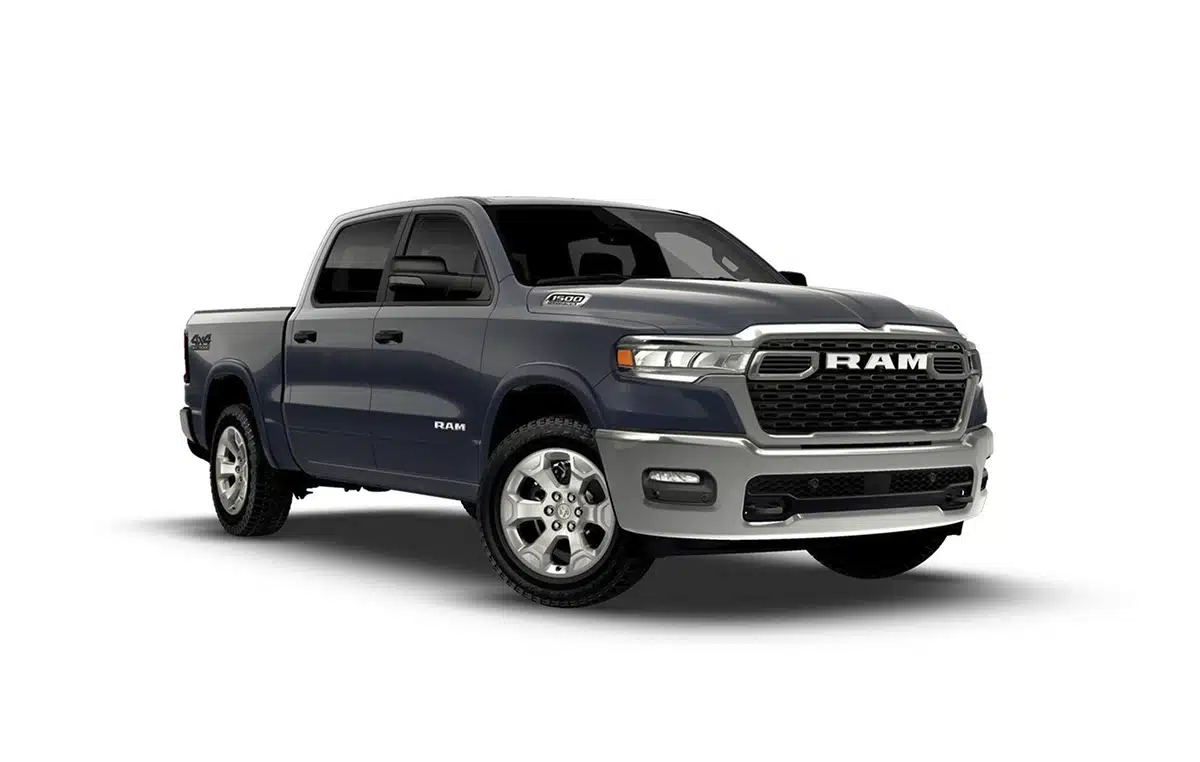
No. 2: 2026 Ram 1500 Big Horn Hurricane, 48/60
My Build
- Big Horn Crew Cab with 5-foot, 7-inch bed and four-wheel drive
- Standard-output 3.0-liter Hurricane
- Eight-speed automatic and 3.55 electronic locking axle
- Big Horn Level 2 Equipment Group
- Trailer Tow Group II
- Off-Road Group
- Heated cloth bucket seats
- 2-kW onboard power system
- Total: $64,545 including destination
The Big Horn allows me to stay below $65,000 while adding equipment that matters. I added Ram’s $995 onboard power system, bringing the total to $64,545. A Laramie may be advertised near this price on a dealer lot, but taxes and fees can quickly push the out-the-door price beyond $70,000.
The engine decision is easy for me. I would choose the standard-output Hurricane. I understand the appeal of a great-sounding V8. I have enjoyed many trucks with deep, growling exhaust notes. The Hurricane is simply quicker, better balanced and more efficient than the Hemi.
It produces 420 horsepower and 469 pound-feet of torque on regular fuel. In my camper test, it maintained speed confidently, cruised around 2,100 rpm at 65 mph and avoided unnecessary gear hunting despite the test truck having a 3.21 axle. It handled the Wildcat Hills without drama and felt more composed than the Hemi. Fuel economy was 8.6 mpg over the 50.5-mile loop.
An important note is I selected the 3.55 axle rather than the 3.92 to keep my price down. Why not go with the 3.92? Modern eight-speed transmissions, strong engine output and Tow/Haul programming make axle ratio less noticeable from behind the wheel than it was years ago. However, axle ratio still changes the official tow rating. This build should tow approximately 8,100 pounds, giving it enough capacity for my 7,000-pound fully loaded camper without pretending it is the best choice for a much heavier trailer.
The Trailer Tow Group adds the integrated trailer brake controller. I skipped the towing mirrors. They are useful while towing, but they obstruct daily visibility. Since I do not tow every week, I would rather have better mirrors every day and accept the compromise while pulling the camper.
The Off-Road Group is important because it adds actual recovery hardware, including tow hooks. Many people assume every four-wheel-drive truck includes front tow hooks. That is not true.
I also selected cloth seats with heat. Buyers expect leather at this price, but much of what is sold as leather is not entirely genuine leather anyway. Leather is freezing in winter and can burn your skin in summer. Cloth is comfortable, durable and relatively easy to clean.
Ram remains one of the comfort leaders. Its coil-spring suspension delivers an excellent ride, the cabin feels thoughtful and the package provides the technology I would use without forcing the truck into luxury pricing.
Ram’s 2-kW onboard power system provides useful output for tools, campsite equipment and lighter emergency loads. It is not as powerful as Ford’s 7.2-kW system, but it adds meaningful utility while keeping this Ram below the price target.
Reliability is less settled. The ZF eight-speed is one of the strongest transmissions in the segment, and current reporting has not identified widespread Hurricane failures. Early complaints include check-engine lights, misfires, thermostat problems and calibration issues. Ram also has recurring electronic, battery-drain, infotainment and build-quality complaints. The 10-year, 100,000-mile limited powertrain warranty increases confidence, but it does not prevent inconvenience.
Related Post: 2021–2026 Ram 1500 Known Problems: Engines, Recalls, Electronics and More
Ram Score
- Powertrain: 9
- Reliability Confidence: 7
- Capability: 8
- Safety: 7
- Comfort and Technology: 9
- Value: 8
- Total: 48 out of 60
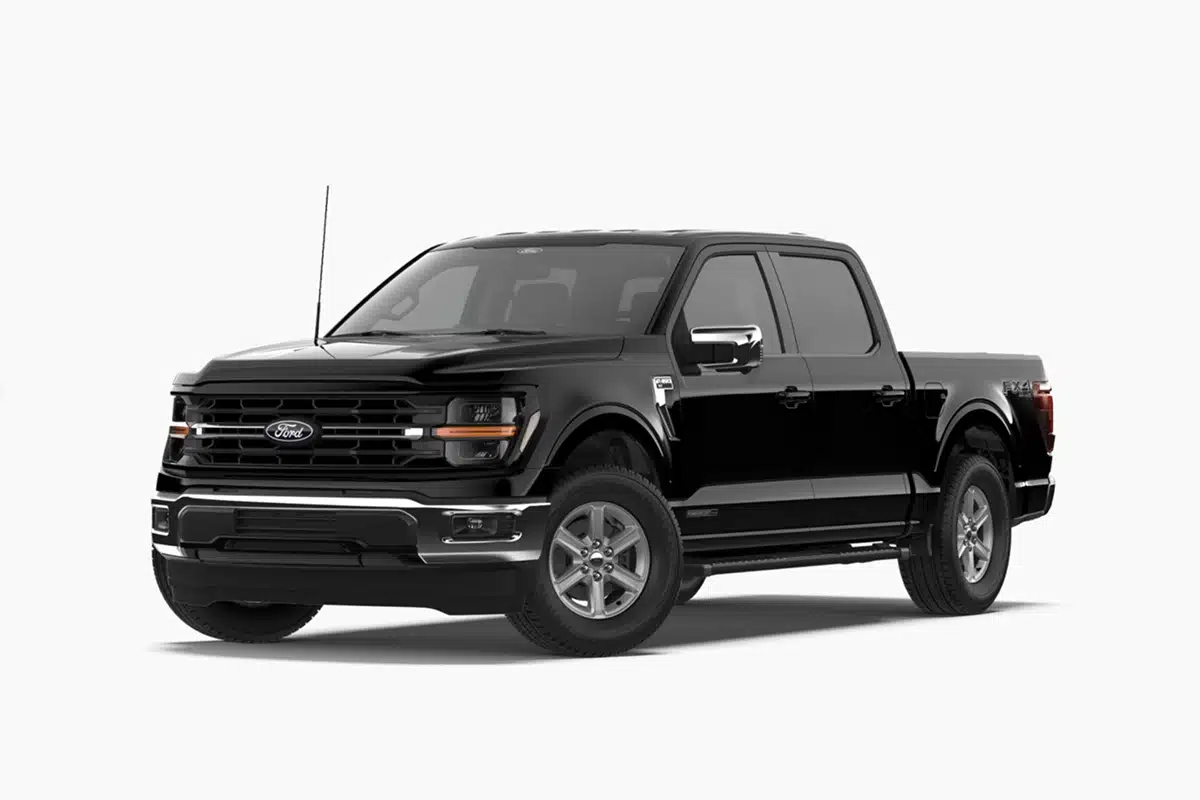
No. 1: 2026 Ford F-150 XLT PowerBoost, 49/60
My Build
- XLT SuperCrew with 5.5-foot bed and four-wheel drive
- 3.5-liter PowerBoost hybrid
- 10-speed automatic and 3.73 electronic locking axle
- XLT Mid 302A
- Tow/Haul Package
- Mobile Office Package
- 7.2-kW Pro Power Onboard
- Heated Medium Dark Slate cloth seats
- Total comparison price: approximately $65,730 including destination and excluding Ford’s lease acquisition fee
This build is similar to the 2021 F-150 PowerBoost I bought in 2020. My current truck is a 2023 F-150 Lariat with the regular 3.5-liter EcoBoost, not the PowerBoost hybrid. I bought that truck as an in-between truck waiting for new 2027 trucks to come out this Fall. If I were replacing that 2023 truck today for another Ford, I would change the engine and return to the PowerBoost.
There is nothing wrong with the regular EcoBoost in my 2023. The EcoBoost has been available for 15 years and has largely proved itself. It simply no longer feels special.
For my money, I would buy the PowerBoost. It combines strong acceleration and towing performance with the most capable onboard power system in this comparison. Ram offers 2 kW, but Ford’s 7.2-kW Pro Power Onboard system provides 3.6 times the rated output and can support substantially larger loads.
That system can power tools, run my camper away from electrical hookups or provide emergency power to a house. Ford has also partnered with Global Power Products to offer the GenerLink transfer switch, which allows compatible F-150 owners to connect the truck’s Pro Power Onboard system directly to their home during an outage. This is the kind of hybrid utility that makes the added complexity worthwhile.
I removed the FX4 Package and spent the money on the 7.2-kW system instead. It was a hard choice, but I had to stay under budget. The FX4 hardware is useful for someone who regularly travels off-road, but onboard power is more useful for more days of my ownership.
Ford’s zone lighting is another overlooked feature. Using the phone or controls inside the truck, I can illuminate different areas around it. The truck can also light the surrounding area as I approach with the key. That is useful when loading groceries, building supplies or camping gear in the dark.
I would stay with XLT. My current truck is a Lariat, and I do not think the higher trim is worth the additional money, especially now that Ford uses ActiveX material rather than traditional leather in many configurations. XLT Mid provides heated cloth seats, power front seats, the larger technology package and other everyday comforts without paying primarily for trim and appearance.
The F-150 also has an exceptionally smooth ride. At times, it rides more like a car than a traditional pickup, which makes it comfortable for commuting and family duty. That will be a strength for many buyers. If you want your truck to feel like a truck, however, look elsewhere. Frankly, I find the F-150 boring to drive.
The PowerBoost towed my camper smoothly and quietly. It was composed on grades, required little driver effort and returned 9.06 mpg on the comparable towing loop. The diesel still feels more relaxed under load, but Ford combines strong towing behavior with considerably more utility when the trailer is parked.
Reliability keeps this from being a runaway winner. Our current reporting does not show widespread EcoBoost, PowerBoost hybrid-system or turbocharger failures. The broader truck has accumulated complaints involving harsh 10-speed shifts, rear-axle bolt recalls, electrical glitches, dead batteries, blank cameras, infotainment problems and rattles. My own PowerBoost developed A-pillar rattles.
The PowerBoost powertrain has a better record than its online reputation suggests. My concern is the number of issues involving the truck surrounding it.
Related Post: 2021-2026 Ford F-150 Known Problems – Transmission, Recalls, Engine Failure?
Safety is another weakness. The F-150 received several Good IIHS scores, but it scored Poor in the updated moderate-overlap front test and vehicle-to-vehicle front crash prevention. It performed better than the Silverado, but it did not qualify for an IIHS award.
Ford Score
- Powertrain: 9
- Reliability Confidence: 7
- Capability: 9
- Safety: 6
- Comfort and Technology: 9
- Value: 9
- Total: 49 out of 60
Why Did the Ford F-150 Win?
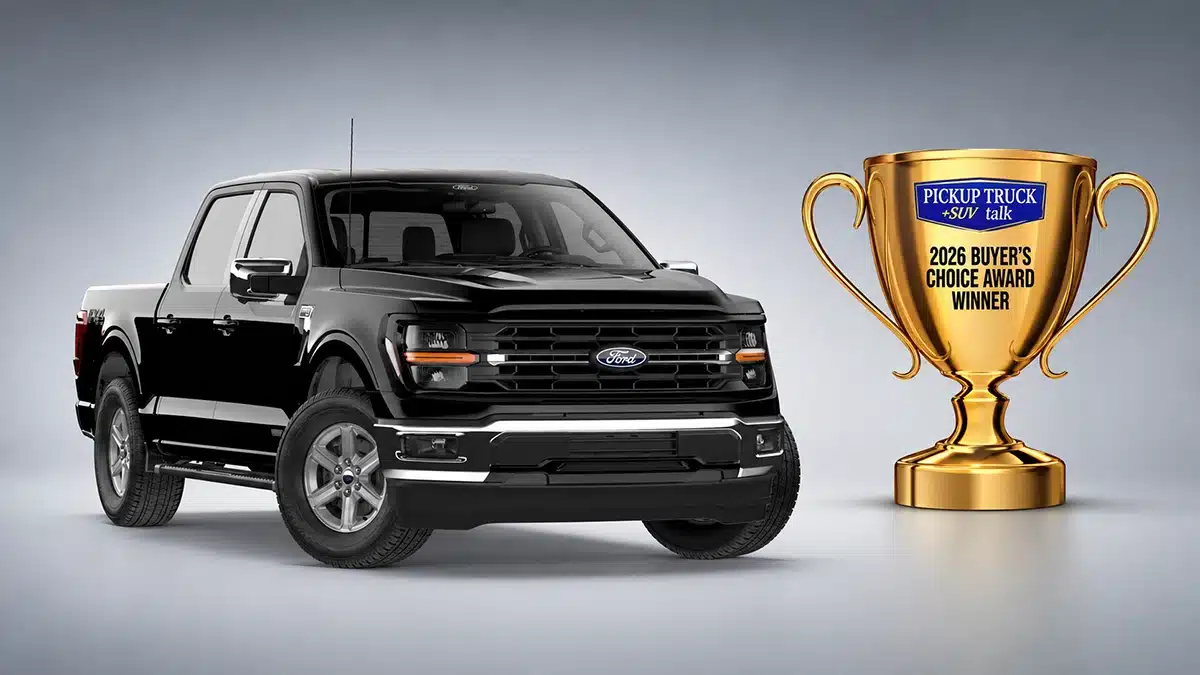
The Ford F-150 PowerBoost wins because it is the most versatile complete tool in this comparison. It combines strong towing performance, a comfortable cabin, logical packaging and the most capable onboard power system available in these five builds.
The Ram finishes only one point behind with excellent performance, superior ride quality and a sensible Big Horn build. GMC’s SLE is the value surprise, while Toyota is the safety leader. Chevrolet delivers the strongest towing-focused configuration, but loses too many points for seat comfort, packaging, price and safety.
The totals are not permanent judgments about these brands. They answer a narrower and more useful question: If I had approximately $65,000 and needed a crew-cab, short-bed, four-wheel-drive family and work truck today, what would I buy?
For 2026, my answer is the Ford F-150 XLT PowerBoost.
That makes it the inaugural Pickup Truck + SUV Talk Full-Size Truck Buyer’s Choice Award winner.
Sources and Related PUTT Reporting







1 reply
Loading new replies...
Administrator
Well-known member
Join the full discussion at the Forum Pickuptrucktalk →