
US logistics companies face rising shipment volumes, tight labor markets, and growing demand for transparency. For logistics operators and 3PLs, a customer portal can make routine information easier to find while giving shippers a clearer view of their freight. The essential features are straightforward: shipment statuses, accessible documents, order related communication, secure access, and a way to measure whether the portal reduces follow up work.
This guide explains how logistics operators can define the essential features of a customer portal, compare the needs of shippers’ managers, accounting departments, and support teams, and measure whether the portal reduces follow up work.
Core Jobs a Shipper Self Service Portal Must Do
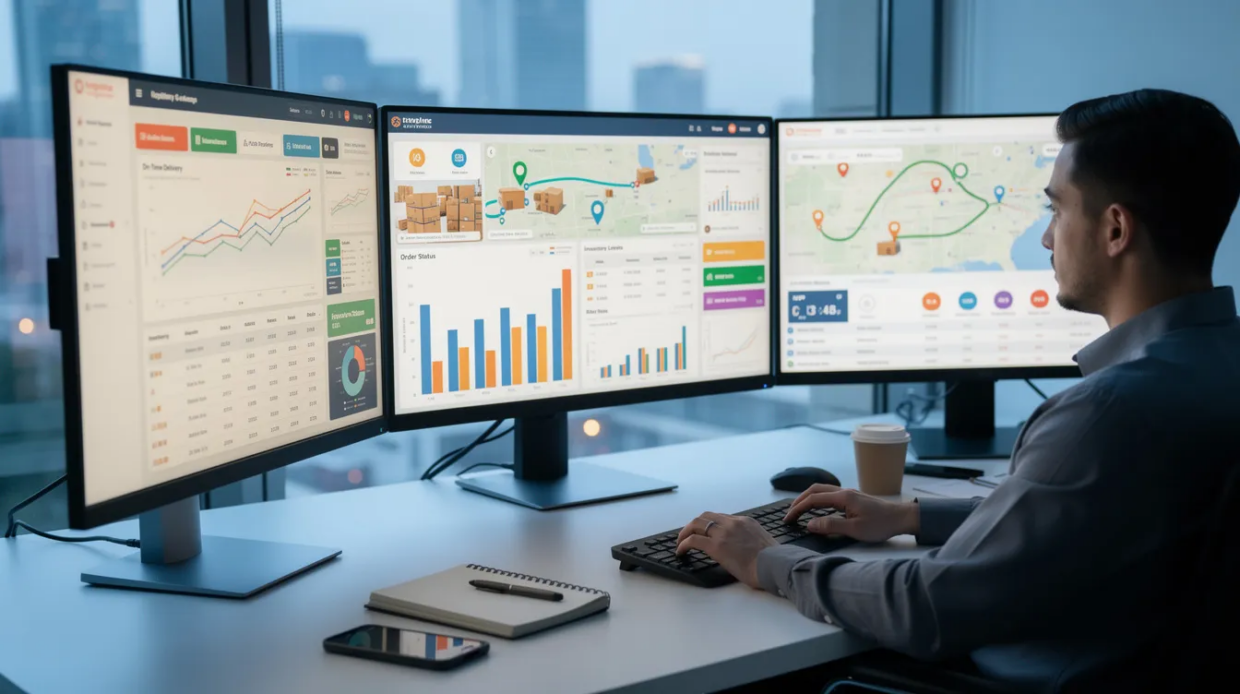
The portal serves as a single view of transportation, warehouse, and order systems. Shippers can track shipments independently while keeping logistics and financial data consistent.
- Visibility for managers. Centralized dashboards let managers filter shipments by customer, lane, and date across first mile, middle mile, and last mile deliveries.
- Accounting access. Give accounting teams controlled access to invoices, rate confirmations, commercial invoices, and proof of delivery documents.
- Support speed. Let support teams find real time shipment status and answer order questions without relying on manual checks.
- Platform flexibility. Integrate the portal with existing cloud native or on premises logistics systems.
Designing Shipment Status and Timeline Views That Actually Help
A shipper self service portal must present shipment details as a linear timeline: booked, picked up, In transit, at terminal, out for delivery, delivered, or exception. Each status event needs a local timestamp, the system source (carrier API, EDI, manual entry), and a last refresh time so users see when data was updated.
Portals facilitate real time tracking of shipments, including estimated delivery times. The tracking relies on GPS, IoT sensors, and carrier integrations for data. Logistics customer portal development requires reconciling multiple data sources into one consistent event stream. As one SoftDoes expert noted, “We stopped losing bids the moment shippers could see their freight without calling us.”
A freight visibility portal combines carrier, GPS, and sensor data to reduce blind spots. Give managers sortable shipment tables, a simple map, fast filters, and CSV export. If live data is unavailable, show the last successful update and label the information as stale.
Document Access: From Email Attachments to a Single Source of Truth
A self service portal can generate bills of lading, packing lists, rate confirmations, customs documents, and claims forms.
- Present documents as a simple list with type, version, and upload or generation date
- Filter by document type and date
- Preview in portal, download as PDF
Use role based shipment document access: accounting sees invoices and credit notes, operations sees transport documents, legal sees claim documentation. Include document APIs so shippers can pull PDFs into their own ERP or other tools rather than downloading manually.
In Portal Communication: Messages Tied to Orders, Not Inboxes
Email and chat apps lose context. Give every shipment and order a message panel so shippers can submit inquiries linked to that record. Each thread should show the question, timestamps, participants, and status: open, waiting on customer, or resolved.
Automated notifications can flag delays and exceptions. File attachments let users share customs documents or photos, while email or SMS alerts direct them to the portal, where the official conversation remains available. This gives logistics teams one place to review an issue and helps prevent duplicate calls.
Customer expectations also extend to proactive updates and clear communication, a point explored in Forbes analysis of customer-centric supply chain management.
Different User Groups, Different Needs: Manager, Accounting, Support
User segmentation drives portal adoption and customer satisfaction. Role based access allows different users to have customized views and permissions.
- Manager: Uses dashboards to review lane performance, dwell times, delivery routes, and exception trends, with drill downs to individual shipments.
- Accounting: Relies on on demand access to invoices, credit memos, contracted rates, surcharges, and payment status to reconcile orders and inventory.
- Support: Benefits from fast search by reference, customer name, tracking number, or order number to answer inquiries quickly.
Security and Data Isolation Between Shipper Clients
Data isolation is non negotiable for large enterprises and their legal teams. The portal must enforce strict tenant isolation so one shipper never sees orders, rates, or documents of another client.
Specify single sign on options, role based access control, and audit logs of who viewed and changed which records. Even when the operator runs a shared TMS instance, the portal should expose only data filtered by shipper ID and legal entity. Companies can reroute shipments with enhanced supply chain visibility when proper controls are in place. Real time visibility reduces delays and improves customer confidence. Include regional controls for data residency when serving US and EU shippers with different regulatory requirements.
Handling Imperfect and Delayed Data in Real Operations
Carrier EDI fails. IoT sensors go offline. Some lanes still depend on manual updates. The portal must show when data is missing or stale instead of hiding gaps behind vague messages like “In transit.”
Predictive analytics enhance freight visibility by estimating arrival times when live GPS is unavailable. Harvard Business Review examines how generative AI can help supply chain teams make faster decisions, improve planning, and respond more effectively to operational challenges. AI enhances real time shipment tracking and predictive analytics, offering graceful fallbacks such as approximate ETAs built from historical averages, labeled clearly as estimates. Freight visibility reduces blind spots and improves proactive decision making. Logistics software enables proactive risk management for timely issue resolution. Include a manual update option with user and timestamp for critical shipments.
Acceptance Criteria and Measuring Post Launch Inquiry Volume
Treat your new logistics software solutions as a product with measurable outcomes. It can reduce costs and help customers find shipment updates without contacting support.
Concrete acceptance criteria:
- User can search any shipment within two seconds
- Shipment detail shows full timeline with source and timestamp
- Key documents download in one click
- Every inquiry tied to an order with status and notification
- Portals can provide automated billing and invoicing to simplify financial management
Choosing a Software Partner for Logistics Customer Portal Development
This is not a generic vendor list but a checklist logistics companies can use when selecting a partner.
- Past experience. Request case studies related to logistics management, freight visibility, or customer portals.
- Tech stack alignment. Assess whether the vendor can integrate with your current TMS, WMS, ERP, and whether they understand both SaaS solution environments and on premises architectures.
- Communication protocols. Define weekly status calls, a single product owner on the client side, and clear escalation rules before the project starts.
- Cost and process transparency. Propose milestone based billing with visible scope, change request procedures, and shared access to the backlog.
- Post launch maintenance. Insist on a support agreement covering security updates, API changes from carriers, and iterative UX improvements based on portal analytics.
Make the Portal Prove Its Value
A useful shipper portal gives managers, accounting, and support secure, reliable answers. Prioritize timestamped statuses, accessible documents, order linked inquiries, and clear stale data notices. Integrate with existing systems, support the portal after launch, and compare inquiry volumes against shipment activity to measure its impact.