A basic OBD2 scanner can be useful when the check engine light comes on, but modern vehicles often require more than simply reading and clearing engine fault codes. ABS, transmission, airbag, battery, and other electronic systems can all generate faults that a basic code reader may not be able to access.
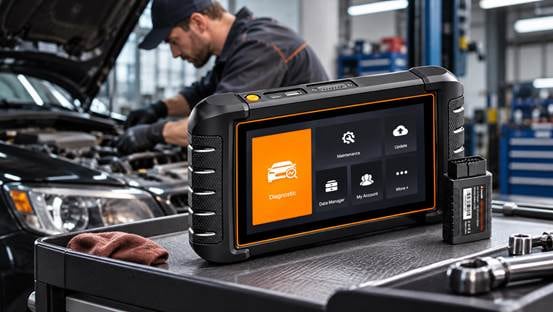
This is where the FOXWELL NT809BT takes a different approach. Rather than focusing only on basic OBD2 functions, it combines full-system diagnostics, bidirectional control, service functions, and wireless connectivity in a single diagnostic tablet.
Beyond Basic OBD2 Diagnostics
The biggest difference between the NT809BT and a basic code reader is the level of vehicle access it provides.
With a basic scanner, a user may be able to retrieve an engine fault code and clear it after a repair. That’s useful, but it doesn’t tell the whole story when a vehicle has problems outside the engine management system.
The NT809BT can access multiple electronic systems on supported vehicles, including areas such as the engine, transmission, ABS, SRS, and battery management system.
For example, if the ABS warning light comes on, the problem may have nothing to do with the engine. Being able to communicate with the ABS module gives the technician another way to investigate the problem rather than relying only on a generic OBD2 reader.
This makes the NT809BT more suitable for users who regularly deal with different types of vehicle faults.
Bidirectional Testing Is Where It Gets More Interesting
Reading diagnostic trouble codes is only one part of troubleshooting. A fault code can point toward a system or component, but it doesn’t always prove that the component itself is faulty.
The NT809BT supports bidirectional control on compatible vehicles, allowing users to send commands to selected vehicle systems and observe how they respond.
This can be useful when checking components such as windows, doors, solenoids, valves, wipers, headlights, and other supported actuators.
Consider a power window that has stopped working. Instead of immediately replacing the motor, a technician can use an available active test to command the system and observe its response. If the component responds, the next step may involve checking the switch or wiring. If it does not, further inspection can focus on the component and its circuit.
This doesn’t automatically identify the cause of every fault, but it provides another diagnostic step between reading a code and replacing a part.
For independent repair shops and experienced DIY mechanics, that distinction can be valuable.
Useful Service Functions for Everyday Repairs
The NT809BT also goes beyond diagnostics with more than 30 supported service functions.
Rather than replacing a separate tool for every maintenance procedure, users can access functions such as oil reset, EPB service, ABS bleeding, steering angle calibration, DPF regeneration, battery matching, and injector coding on supported vehicles.
The value of these functions depends on the type of work a user normally performs.
For someone servicing a vehicle with an electronic parking brake, for example, an EPB service function can be useful during brake maintenance. A technician working on a diesel vehicle may also benefit from supported DPF regeneration functions when dealing with a clogged or loaded particulate filter.
Injector coding is another example. On vehicles that require injector calibration information to be entered after injector replacement, the appropriate service function can help complete that procedure.
However, these functions should not be treated as universal. The exact functions available depend on the vehicle’s make, model, year, and system configuration.
Wireless Diagnostics for Greater Flexibility
The NT809BT uses a Bluetooth VCI to communicate with the vehicle, giving users more freedom to move around the vehicle during diagnostics.
That may seem like a small detail, but it can become useful during active testing.
A technician may need to operate the scanner from the driver’s seat and then move to the engine compartment to observe a component. A wireless connection eliminates the need to keep a long diagnostic cable connected between the tablet and the vehicle.
The 7-inch tablet display also gives users more room to view live data and diagnostic information than a small handheld code reader.
For workshop use, the combination of a tablet interface and wireless VCI makes the diagnostic process more flexible without changing the basic workflow.
What About Vehicle Compatibility?
This is one area where buyers should pay attention.
Having access to a large number of vehicle brands does not mean every advanced function will work on every vehicle. Diagnostic coverage can vary according to the vehicle’s make, model, year, control module, and software support.
For example, a vehicle may support full-system diagnostics while a particular active test or service function is unavailable.
That’s why the most important question isn’t simply whether the scanner supports a particular brand. Buyers should check whether the specific function they need is supported for their vehicle.
This is particularly important when purchasing a diagnostic tool for a specific repair task.
Who Is the NT809BT For?
The NT809BT makes the most sense for users who have outgrown basic code readers.
Independent repair shops can benefit from having full-system diagnostics, active tests, and service functions in one device rather than relying on several basic tools.
Professional and mobile technicians may appreciate the wireless VCI because it makes it easier to move around the vehicle while performing diagnostics.
Experienced DIY mechanics can also benefit if they regularly perform their own repairs and want more than simple check-engine-light diagnostics.
On the other hand, a driver who only wants to read and clear basic engine codes probably doesn’t need a tool with this level of functionality. A simpler OBD2 scanner would likely be sufficient.
Final Verdict
The FOXWELL NT809BT is best viewed as a step up from a basic OBD2 code reader rather than a replacement for high-end programming equipment.
Its strongest combination is full-system diagnostics, bidirectional active testing, and a broad selection of service functions. These capabilities give users more ways to investigate a problem before replacing parts or sending a vehicle to a repair shop.
The wireless Bluetooth VCI is another practical advantage, particularly for technicians who need to move around the vehicle during testing.
There are limitations. Advanced functions remain vehicle-dependent, and the NT809BT should not be confused with an ECU programming or coding platform.
For experienced DIY mechanics, independent repair shops, and technicians who want a more capable diagnostic tool for everyday troubleshooting and maintenance, the NT809BT offers a practical balance between basic code reading and more advanced vehicle diagnostics.