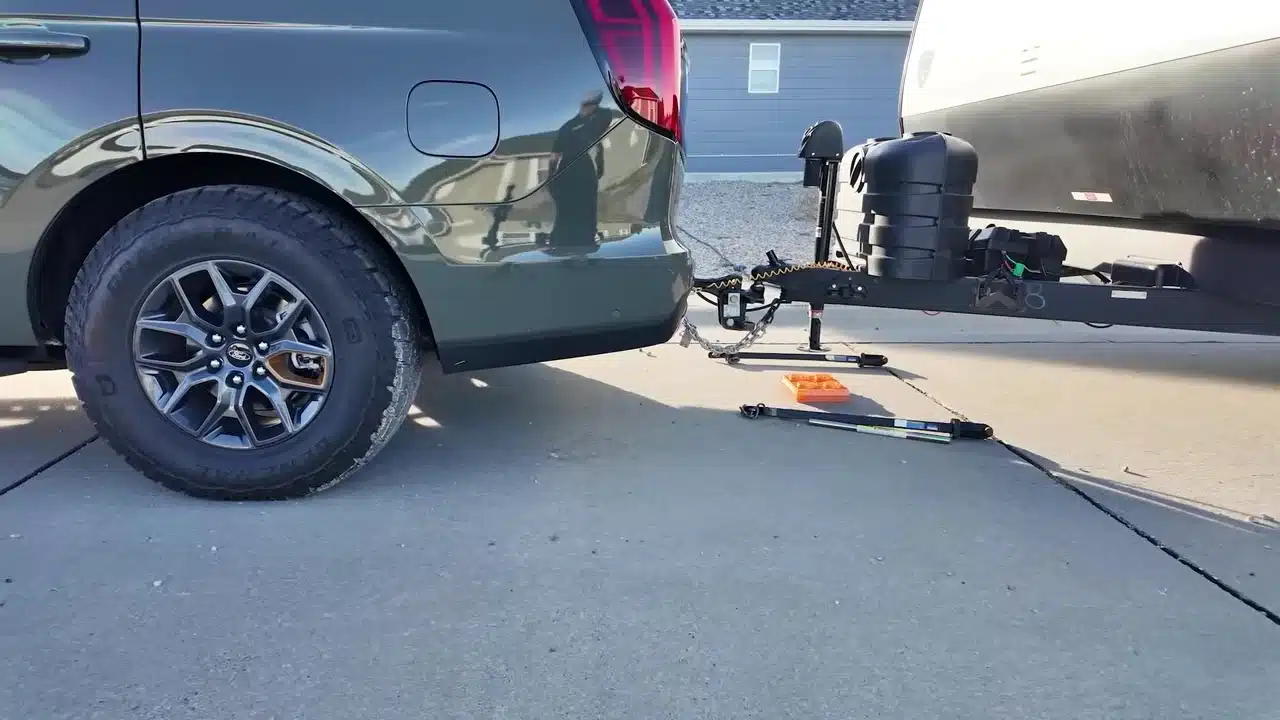
Your crew hitches a 5,000-pound equipment trailer to a work pickup, loads two mowers and crosses the state line for a morning job. Nobody on board holds a CDL or thinks of the trip as trucking. Federal regulators may disagree.
An ELD comes into play only after three conditions align. Your pickup and trailer must together count as a commercial motor vehicle, the day’s work has to call for a record of duty status, and no exception can cover it. A small landscaping fleet serves as the running example throughout.
How Does a Work Trailer Change Your Pickup’s DOT Classification?
Plenty of small fleet owners assume a pickup is exempt by nature. Federal rules judge the whole rig. Under 49 CFR §390.5T, a vehicle or combination used in interstate commerce qualifies as a commercial motor vehicle (CMV) at 10,001 pounds or more of weight rating or actual weight, whichever figure is greater.
Two ratings feed that test. Gross vehicle weight rating (GVWR) is the manufacturer’s maximum loaded weight for one unit, printed on its certification label. Gross combination weight rating (GCWR) takes the higher of the pickup’s manufacturer GCWR, if displayed there, or the largest sum of GVWRs or actual weights for truck and trailer. Brochure towing capacity plays no part.
Cedar Hill Grounds, a hypothetical landscaping company in Kansas City, Missouri, runs two pickups rated at 7,200 pounds GVWR. Both tow equipment trailers with a 5,000-pound GVWR. Added together, the ratings put a hitched combination at 12,200 pounds or more, over the threshold even with an empty trailer. Unhitched, a pickup drops back out of CMV territory, because the regulation ignores a power unit’s GCWR if it is towing nothing.
Hauling the company’s own mowers and skid steers doesn’t change the result. Moving its own gear makes Cedar Hill a private carrier, and a crew that crosses into Kansas for a job is operating in interstate commerce. Trips that never leave Missouri answer to that state’s law, where thresholds can differ.
Licensing sets a much higher bar. FMCSA’s CDL classifications start Class A at a 26,001-pound GCWR with a towed unit over 10,000 pounds. None of Cedar Hill’s drivers needs a CDL.
A Pickup Can Be a CMV Without Automatically Needing an ELD
Reaching 10,001 pounds brings the driver under federal hours-of-service (HOS) rules. Licensing (Part 383) and HOS (Part 395) use separate thresholds, which means a Cedar Hill driver with an ordinary license faces the 11-hour driving limit and the 60-hour/7-day or 70-hour/8-day limits in §395.3, subject to exceptions.
HOS rules decide the paperwork. A day that fits a short-haul exception needs only an employer time record showing start, release and total on-duty hours. Outside those conditions, the driver has to complete a record of duty status (RODS) for the day. Paper logs remain acceptable up to eight RODS days in any 30-day period; beyond that, unless another exemption applies, the entries must come from a registered ELD.
Can a Local Pickup Crew Work All Day Without an ELD?
Marcus reports to the Cedar Hill yard at 6:00 a.m., inspects his pickup and loads the mowers. By 6:45 he is on the road to a property in Overland Park, Kansas. He spends the bulk of the day there mowing and edging, with a couple of short hops between neighboring lots, then drives back at 3:30, unloads and clocks out at 5:00.
No ELD is involved, though nearly the whole shift counts as on duty. Section 395.2 puts loading, unloading, vehicle inspection and other carrier tasks in that category and limits driving time to the minutes spent at the controls. Marcus is behind the wheel for roughly two and a half hours, but mowing eats into his workday window just as the road does.
The 150-Air-Mile Rule and Daily Return Requirement
Marcus meets the standard short-haul exception in §395.1(e)(1). It requires the driver to stay within 150 air miles (172.6 statute miles) of the normal work reporting location, return and be released inside 14 consecutive hours, and get at least 10 straight hours off between shifts. Cedar Hill keeps his time records for six months, plus seven-day totals for new or intermittent drivers.
Air miles measure a straight-line radius from the yard. A day of winding service calls can put 200 on the odometer without leaving that circle.
Why Qualifying Non-CDL Drivers Can Have Different 14- and 16-Hour Limits
Drivers like Marcus have a second option. Section 395.1(e)(2) covers property-carrying CMVs that require no CDL, driven within 150 air miles by a driver who returns to the normal reporting location at the end of each workday. Driving is barred past the 14th hour on duty on five days of any seven consecutive days, and past the 16th hour on the other two.
Say a storm hits and Marcus clears debris until 8:30 p.m. A 14.5-hour day breaks (e)(1), but under (e)(2) it can serve as one of his two 16-hour days in that seven-day period. That longer window delays the cutoff without adding drive time. His 11-hour cap and 60- or 70-hour limits remain in force. A driver relying on (e)(2) also can’t fall back on (e)(1).
What Changes as a Local Pickup Starts Making Longer Hauling Trips?
Breaking any short-haul condition triggers a RODS requirement for that day. Tyler, Cedar Hill’s installer, hits that point on every trip that takes a skid steer to a customer 220 air miles away.
One trip is no reason to buy an ELD. Paper RODS are allowed by §395.8(a)(1)(ii)(A) for a driver who needs them on no more than eight days within any 30-day period. FMCSA guidance treats that window as rolling, with June 15 to July 14 given as an example, so calendar months don’t reset the count. Those days follow Tyler from truck to truck, and a delivery spanning two days counts twice.
Here is how his days added up:
| Date | Why Tyler needed a RODS | RODS days in the 30 days ending that date |
| Oct. 3–4 | Two-day equipment delivery | 2 |
| Oct. 10 | Out-of-radius install | $3.00 |
| Oct. 17–18 | Two-day delivery | $5.00 |
| Oct. 24 | Out-of-radius install | $6.00 |
| Oct. 29 | Late return outside both short-haul windows | $7.00 |
| Oct. 31 | Out-of-radius install | 8 |
| Nov. 1 | Equipment delivery | 9 |
Nov. 1 ends the paper option. That delivery adds a ninth RODS day inside the Oct. 3 to Nov. 1 window, so that day must go on an ELD. Had dispatch pushed the job to Nov. 3, the Oct. 3 and 4 trips would have aged out, leaving seven days and keeping handwritten logs available.
Two other ELD exceptions cover driveaway-towaway operations and vehicles built before model year 2000. Neither tends to fit a working pickup fleet. Even where one applies, the HOS limits hold.
Three Drivers, Two Pickups: Who Actually Needs an ELD?
By early November, Cedar Hill has three drivers on different record types, all of them correct. Earlier assumptions carry over: 12,200-pound combinations, interstate work, no CDLs and no extra exceptions.
Marcus runs local routes on both sides of the state line and sleeps at home nightly. His lone storm day fit the non-CDL short-haul rule, and his whole month stays on time records, with no RODS and no ELD. A pair of October deliveries gave Elena five RODS days on top of her usual nearby jobs. She logs them on paper, which stays legal as long as her rolling 30-day total holds at eight or below.
Tyler is a different story. Nine RODS days inside Oct. 3 to Nov. 1 generally put him on an ELD from Nov. 1 onward, and the requirement travels with him. If he takes the shared second pickup on a logged day, that truck needs an FMCSA-listed ELD with Tyler signed in. Marcus can drive that pickup on a short-haul day and stay on time records.
Some owners skip the sorting and put every driver on an ELD, which the rules allow.
What to Verify Before a Pickup Leaves the Yard
For a fleet this size, compliance comes down to record-keeping done before dispatch. Cedar Hill keeps the following on file:
- Pickup GVWR, trailer GVWR and any label GCWR for every hitch combination
- Reporting location for each driver, with the 150 air-mile boundary drawn around it
- Daily report and release times plus total on-duty hours, held for half a year
- A rolling 30-day tally of RODS days per driver, checked before booking an out-of-radius job
- RODS and supporting documents for at least six months under §395.8(k), with drivers carrying the previous seven days
GPS route history helps reconstruct a day after the fact. By itself, it can’t stand in for a time record or a RODS.
Device choice now deserves extra scrutiny. On Nov. 12, 2026, FMCSA removed 133 ELDs from its registered list in one action, the largest removal on record, according to Heavy Duty Trucking. Of those, the agency revoked 121, and providers withdrew the other 12. Registration rests on provider self-certification. A familiar brand name proves nothing about a specific model.
Start by matching the model number and ELD identifier against the registered and revoked tabs of FMCSA’s ELD list. Have the provider confirm that the unit plugs into your pickup and captures engine data for that vehicle. Separate accounts for each driver are also required by §395.22. Equipped pickups must carry data-transfer and malfunction instruction sheets plus blank graph-grids for at least eight days.
For Tyler’s trips, it’s worth looking at Matrack ELD. Its MA-ELD hardware appears on FMCSA’s list, and HOS logs sit alongside inspection reports and GPS tracking on one fleet platform. Ask which model identifier ships with your order and whether it supports your truck.
Making the Call Driver by Driver
Weight decides whether federal rules reach the pickup. From there, the shape of the workday settles the short-haul question, and a driver’s rolling RODS count shows how long paper logs can last. Intrastate trips need a separate check against state law. Any device should clear FMCSA’s lists ahead of installation.