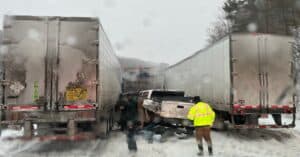
A chain-reaction crash can begin with one sudden event and involve several vehicles within seconds. One driver brakes, another cannot stop in time, and the first impact may push vehicles into neighboring lanes or into traffic approaching from behind. Determining how the sequence started requires separating the original hazard from the collisions that followed.
Georgia’s crash-reporting system specifically recognizes traffic congestion, backups caused by an earlier crash, secondary crashes, incident-response scenes, and disabled vehicles in travel lanes as potential roadway contributing factors. Those categories illustrate why investigators often reconstruct the entire traffic sequence instead of treating every impact as an isolated collision.
1. Following Distance Leaves Too Little Room for an Emergency Stop
A driver traveling too close to the vehicle ahead has less distance available when traffic suddenly slows. That problem can spread through several vehicles when each driver has progressively less time to react to braking farther ahead.
The distance that is reasonable depends on traffic speed, roadway conditions, and what is happening ahead. NHTSA research into rear-end crashes has examined following distance together with closing speed and braking because these factors affect whether a following vehicle has enough room to avoid a collision. When several cars are closely spaced, the first hard stop can create a sequence of impacts rather than a single rear-end crash.
2. Excessive Speed Can Reduce the Time Available to Respond
Speed affects both reaction opportunities and stopping distance. NHTSA explains that speeding reduces a driver’s ability to steer safely around unexpected hazards and extends the distance needed to stop a vehicle.
That becomes especially significant in dense traffic. A driver approaching slowing vehicles at a higher speed experiences a greater closing rate, leaving less time to recognize the queue and brake. If the first collision blocks additional lanes, vehicles farther back may encounter an obstruction that did not exist moments earlier. Investigators may therefore examine speed alongside braking marks, video, vehicle data, and traffic conditions.
3. Distracted Driving Can Delay Recognition of a Developing Queue
Chain-reaction crashes often depend on when each driver first recognizes the danger ahead. NHTSA defines distracted driving as any activity that diverts attention from driving, including phone use, eating, interacting with passengers, or adjusting navigation and entertainment systems.
A delayed response can matter even when the distracted driver is not the first vehicle involved. Traffic ahead may already be braking normally, but a driver who does not notice the slowdown can strike the rear of the queue and push vehicles forward. Phone records where legally obtainable, interior or exterior camera footage, witness accounts, and electronic vehicle information may help investigators determine whether attention was diverted before impact.
4. A Prior Collision Can Create an Unexpected Traffic Backup
One crash can create conditions for another. FHWA describes secondary crashes as incidents associated with an earlier crash or other roadway event, including crashes occurring in traffic queues that form behind the original incident.
When a car crash lawyer in Lawrenceville evaluates a multi-vehicle collision, the timing of an earlier roadway incident may therefore become important. Georgia’s official crash-reporting materials specifically include “backup due to prior crash/secondary crash” and traffic congestion among roadway contributing factors. Investigators may compare incident times, roadway cameras, 911 records, traffic-management information, and vehicle positions to determine whether an earlier event created the sudden slowdown.
5. Rain, Fog, or Slick Pavement Can Change the Margin for Error
Weather can turn ordinary slowing traffic into a more difficult braking situation. FHWA identifies rain, freezing precipitation, low visibility, high winds, and slippery road surfaces as adverse weather conditions that can affect roadway safety.
Reduced visibility can prevent drivers from recognizing a traffic queue as early as they normally would, while wet or icy pavement can change available traction during braking. Georgia crash-reporting materials separately identify standing water and wet, icy, snowy, or slushy road surfaces as potential contributing conditions. Weather observations, roadway cameras, photographs, and witness descriptions can help establish what drivers encountered when the sequence began.
6. An Unsafe Lane Change Can Introduce a New Conflict
A chain reaction does not always begin with traffic directly ahead. A vehicle moving suddenly into another lane can force surrounding drivers to brake, swerve, or change lanes themselves. Those evasive actions can create additional conflicts in neighboring traffic streams.
The sequence can become difficult to reconstruct because the vehicle that triggered the first reaction may not sustain the most damage. Investigators may need video, witness accounts, lane markings, impact locations, and vehicle positions to determine which movement occurred first. Georgia crash-investigation guidance emphasizes documenting physical evidence, driver and witness information, available camera footage, vehicle data, and the sequence of events when identifying contributing factors.
7. Disabled or Crashed Vehicles Can Remain Hazards to Approaching Traffic
A stopped vehicle in a travel lane can create another stage of a chain-reaction collision. Drivers approaching the scene may encounter damaged vehicles, debris, responders, lane closures, or suddenly slowing traffic before the roadway has been cleared.
Georgia DOT’s Highway Emergency Response Operators are tasked with clearing traffic incidents and stalled vehicles from metro Atlanta freeways, in part to restore normal traffic flow. The department’s CHAMP program similarly provides traffic control and roadway clearance and states that these activities help reduce secondary incidents.
A disabled vehicle is also specifically listed in Georgia’s crash-reporting materials as a possible roadway contributing factor. That makes the timing of the first collision, vehicle disablement, emergency response, and subsequent impacts relevant when determining whether later drivers encountered a newly created roadway hazard.
Reconstructing a Chain Reaction Requires Identifying the First Critical Event
The vehicle that causes the greatest damage is not necessarily the one that started the sequence. A closely following driver, sudden lane movement, distracted response, traffic queue, weather condition, or disabled vehicle may have created the first critical conflict several seconds before the final impact.
Investigators can compare roadway video, photographs, crash reports, witness statements, vehicle damage, electronic data, traffic-management records, and final vehicle positions to place those events in order. Georgia’s crash-investigation guidance describes this process as collecting and analyzing physical evidence and other information to determine the conditions, behaviors, contributing factors, and sequence that produced the crash. Reconstructing that complete sequence can help distinguish the event that triggered the chain reaction from the impacts that occurred afterward.