Last week, Stellantis offered a group of media an early look at a new piece of technology from the SRT group called eBoost Air. Introduced on a Jeep Grand Cherokee that was fitted with the Hurricane High Output inline-six from the Dodge Charger, this system vastly reduces the time taken to reach peak boost in a vehicle with a turbocharged engine. This system is in the infancy of development, with last week’s introduction coming just seven weeks after the idea of the eBoost Air system was proposed, but it already made a dramatic different in the performance of this uniquely-powered Jeep.
We have already experienced the system in action during the Roadkill Nights Powered by Dodge media preview, but with some people believing that this is the formal introduction of the next generation Jeep Grand Cherokee SRT, we wanted to take a look at this new technology and the SUV in which is is being developed.
How Turbocharging Works
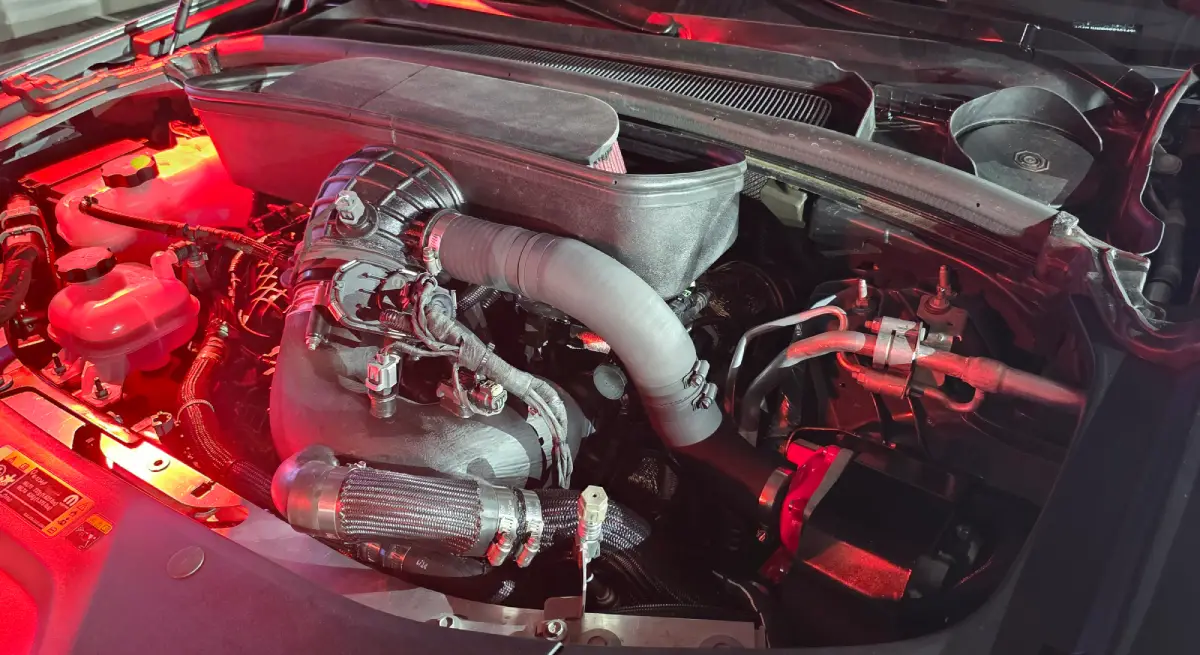
Before understanding how the eBoost Air system works, you have to understand how turbocharging works. While many readers do understand how a turbocharger works, some may not, so here is a quick explanation of how the turbochargers on the Hurricane I6 engines in the Dodge Charger, Ram 1500, Jeep Wagoneer line and this unique Jeep Grand Cherokee work in their normal applications.
Turbochargers are mounted inline of the exhaust system, usually right off of the exhaust manifold. The inner workings of the turbocharger are spun on the “hot side” by the flow of exhaust gases coming from the engine and as the hot side of the turbocharger begins to spin faster from increased exhaust flow, the cold side of the turbocharger begins compressing more air into the intake system of the engine. The key issue with turbochargers is that at low engine RPM, the exhaust gas flow is too low to spin the turbochargers fast enough to create the levels of boost needed to make power. The period of time from when you hit the throttle to when the engine is creating enough exhaust flow to get the turbochargers up into the boost is called turbo lag, and it is the only real downside to this type of forced induction.
The larger the turbocharger, the more exhaust gas flow that is needed to get them up to speed for peak boost, so most automakers use relatively small turbochargers to reduce turbo lag on production vehicles – especially on low performance production vehicles.
How SRT eBoost Air Works
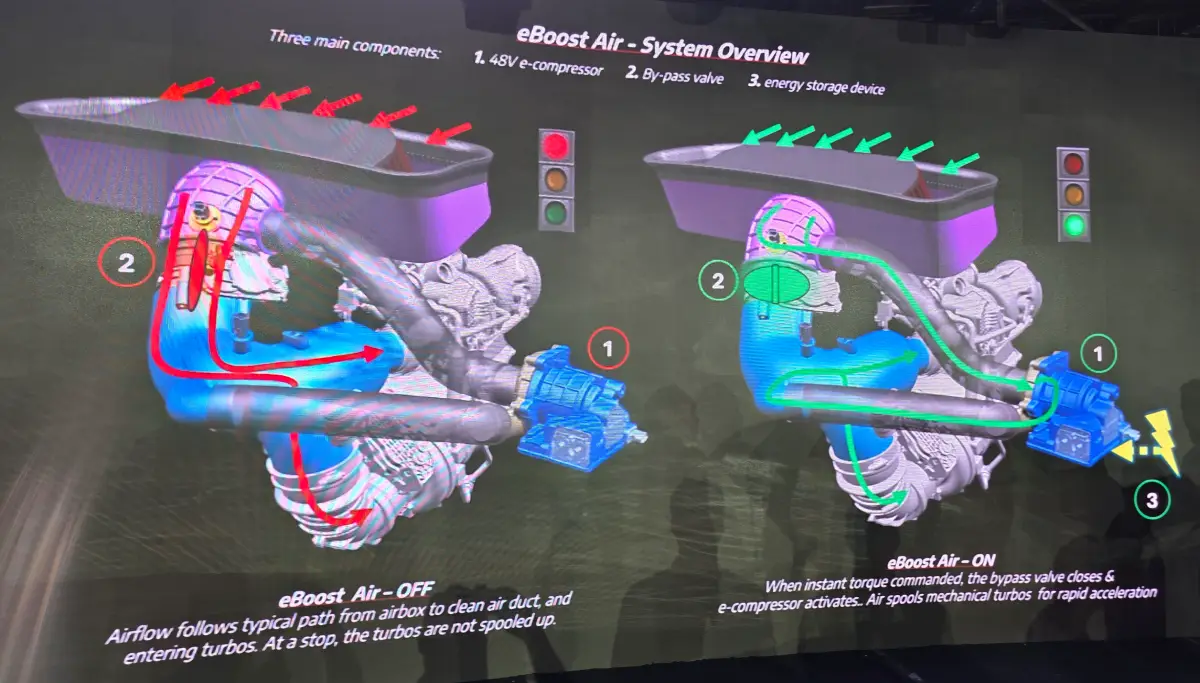
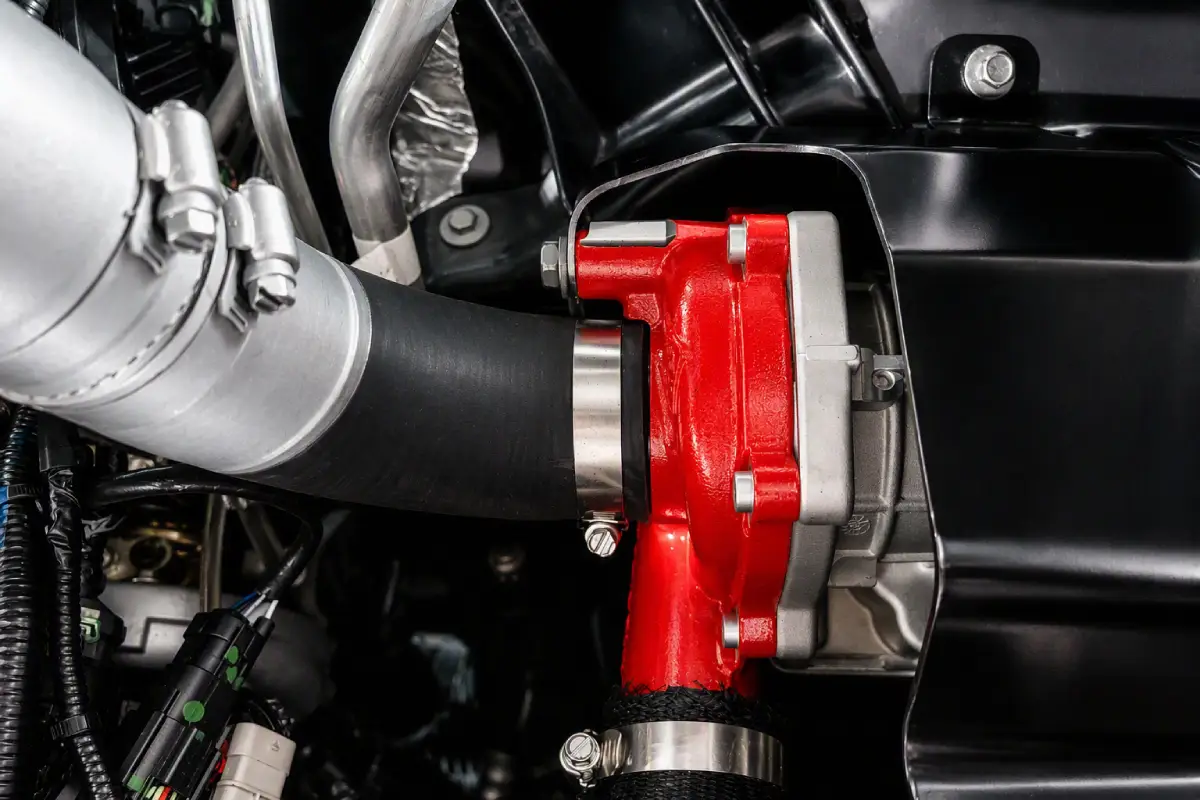
The key component of the SRT eBoost Air system is an electric motor – essentially an electric air compressor motor– that is connected to the turbochargers and the air box in this Jeep by a series of tubing that runs in parallel with the traditional air intake tubing of the turbocharging layout. When the eBoost Air system is engaged, a bypass valve below the airbox stops sending air through the piping headed directly to the turbochargers, instead sending it to the eBoost Air air pump. From there, the eBoost Air motor begins forcing the air through the turbochargers, increasing their internal speed and getting them up into their boost levels without any increased exhaust flow. Once the vehicle is moving and engine speeds increase to the point where the exhaust gas flow is enough to spin the turbochargers faster than the electric motor, the valve near the airbox sends all air to the turbochargers rather than to the electric compressor. The graphic above shows the normal air path on the left and the path of air when eBoost Air is active on the right.
As mentioned above, this system has only been in development for about seven weeks, so there is plenty of work left to be done on the system, but right now, it is working very well on this Jeep Grand Cherokee. While the SRT team is continuing to work with different sizes of motors, the setup that we experienced offers gets the engine up to about 10 pounds of boost before the exhaust gases step in to lift boost to peak levels, which is over 30 pounds. In other words, the eBoost Air system does not bring the turbochargers up to peak boost, so on a hard launch, there is some time where you can feel the boost build, but the dead zone on launch with a stock Hurricane, where there is next-to-no boost, no longer exists. Also, this system allows the engine to get up to peak boost more quickly, so while it does not totally eliminate all delay between idle and peak boost, eBoost Air dramatically decreases the delay between launch and peak power output. This improved performance not just from a stop, but also when asking for a big shot of power when already in motion.
“Enthusiasts aren’t interested in technology for the sake of technology. But when technology improves performance with no downside, they’re all in,” said Tim Kuniskis, head of American brands and marketing, North America. “eBoost Air delivers exactly that kind of tangible benefit. It’s a smart, simple idea that attacks turbo lag head-on and reflects what SRT does best—moving fast, challenging assumptions and chasing more performance.”
This Jeep Grand Cherokee is SRT’s Rolling Laboratory
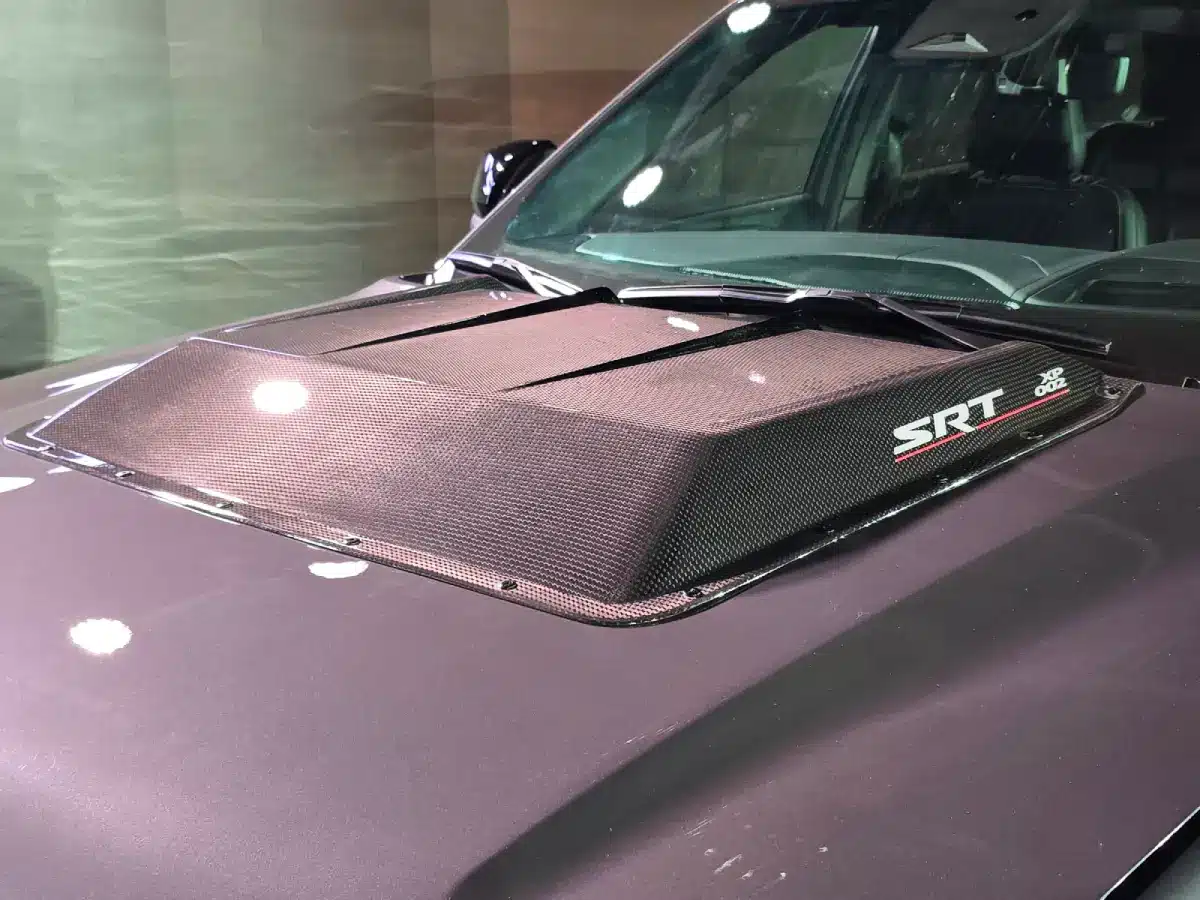
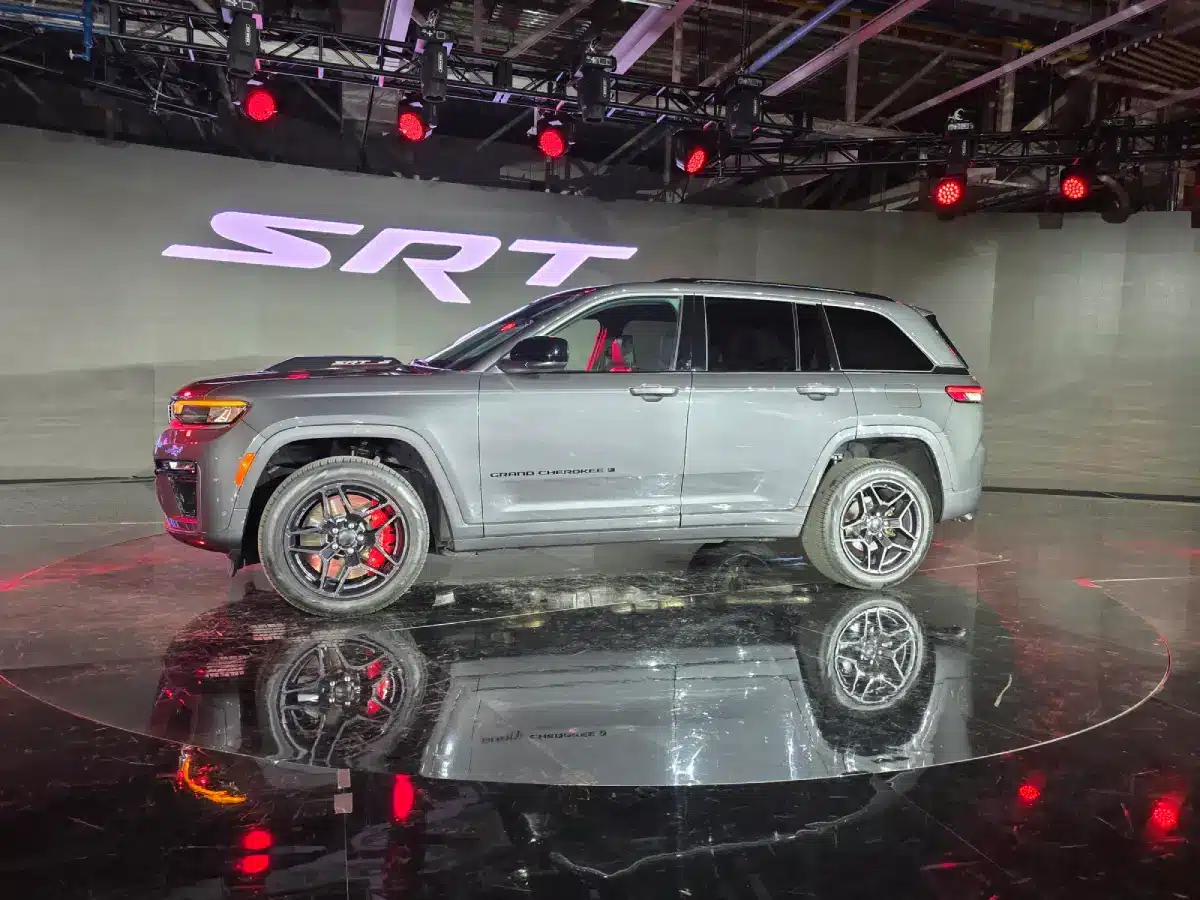
During the media event at which the Jeep Grand Cherokee with the SRT eBoost Air system installed on the Hurricane High Output engine, I asked a member of the development team what exactly they were calling this vehicle. Is it an SRT Jeep Concept? Jeep Grand Cherokee SRT Concept? He told me that they really don’t call it a Jeep Grand Cherokee at all but a more fitting name would be the SRT Rolling Laboratory.
Some outlets were quick to label this as the next Jeep Grand Cherokee SRT, but the Rolling Laboratory as it sits now falls short of a proper SRT model. Right now, it is powered by the 3.0-liter Hurricane High Output engine with some minor changes and tuning to add 90 horsepower. They were quick to point out that eBoost Air does not add any power, it just reduces boost lag. The added power come from removal of restrictions in the exhaust system and associating tuning changes that add 90 horsepower. Since the Charger Hurricane H.O. offers 550 horsepower in stock form, adding 90 horsepower should yield 640 horsepower, but the company reps on hand never said that number – they just kept saying that it adds 90 horsepower.
This isn’t the next generation SRT Jeep, but rather, the vehicle that is being used to test technology that the SRT group could soon use to improve the performance of all of the company’s turbocharged vehicles. Right now, they are working on the Hurricane I6, but eBoost Air could allow a turbocharged Hemi to hit very similarly to the supercharged Hellcat Hemi.
“The SRT division is leveraging rapid development and cross-functional engineering to evaluate emerging performance technologies,” said Tom Sacoman, head of SRT operations. “In this case, by electromechanically pre-spooling the turbochargers before exhaust energy is available, we’re able to significantly improve boost response and drivability.”
Current Roadblocks of Factory Implementation
The SRT division is still working on perfecting this system on the Hurricane-powered Jeep Grand Cherokee test vehicle, working with different sized motors and other variables in planning the hard components of the system. The other key issue is that the eBoost Air uses a 48-volt compressor motor, while combustion-powered vehicles (non-electric vehicles) run on a 12-volt electric system. The needs of the 48-volt motor require some sort of enhanced electrical system, a dedicated battery or capacitor to be able to deliver that shot of added electricity. Right now, since the system is using 48 volts from a 12-volt system, it can only be used for short bursts with required downtime while the electrical system regenerates, but based on the design of the system, it is only needed in short bursts.
Based on my time riding in the passenger seat of this Jeep Grand Cherokee with the SRT eBoost Air system and watching from trackside of the Roadkill Nights drag strip, the performance improvements are very clear when compared to a stock Dodge Charger SixPack Scat Pack or any of the other Hurricane-powered vehicles on the market today, They have not totally eliminated the time taken to reach peak boost from a turbocharged engine, but eBoost Air removes the periods of acceleration when the turbochargers aren’t spinning fast enough from exhaust gases to offer any boost at all.