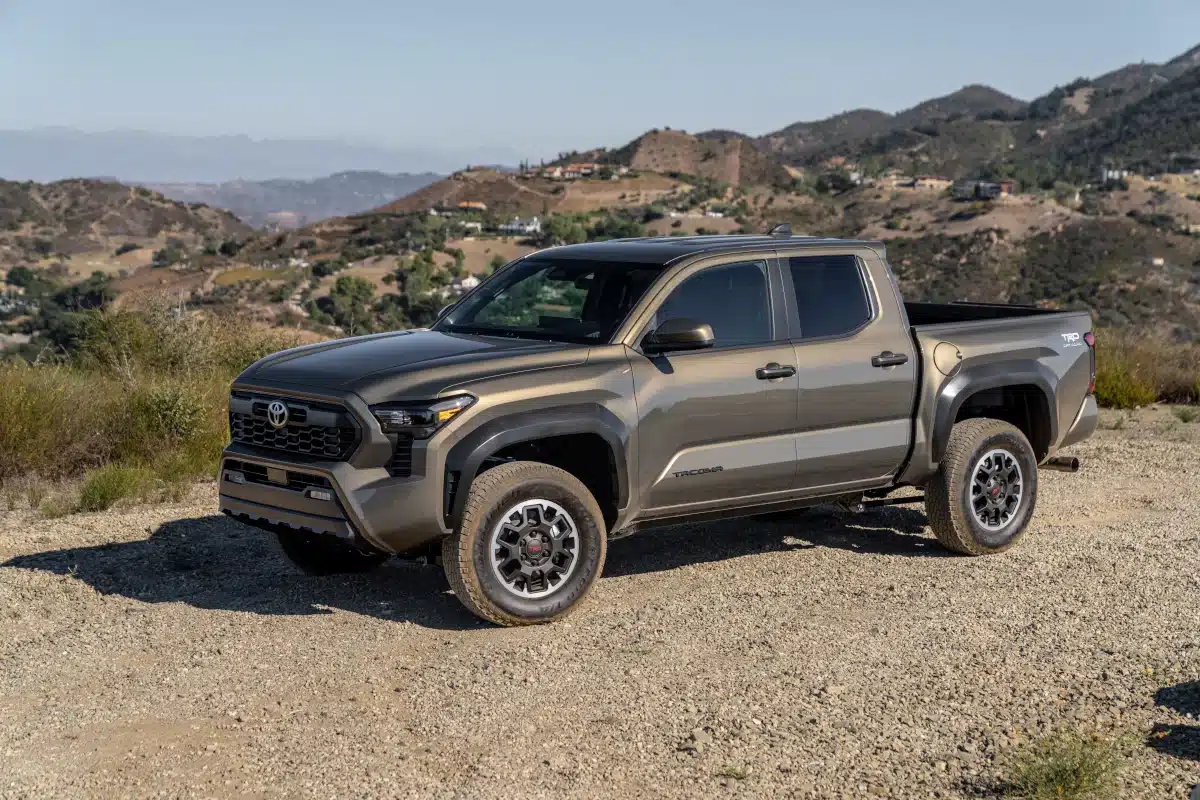
A recall of 48,280 Toyota Tacoma trucks for shock absorber oil reservoirs that may detach due to corrosion.
Toyota Motor Engineering & Manufacturing (Toyota) is recalling certain 2024 Tacoma Hybrid and 2024-2025 Tacoma vehicles. The metal flange on the front and rear shock absorbers may corrode and fail, resulting in detachment of the external oil reservoir.
Affected VINs should be searchable now at the NHTSA website.
Here is the relevant information from the NHTSA Recall notice:
NHTSA ID Number: 26V514
Manufacturer: Toyota Motor Engineering & Manufacturing
Components: SUSPENSION
Potential Number of Units Affected: 48,280
Estimated percentage with defect: 1%
Descriptive Information
(1) Although the involved vehicles are within the above production period range, not all vehicles in this range were sold in the U.S.
(2) This issue only affects the vehicles listed in the NHTSA 573 report, which are equipped with certain shock absorbers from a specific supplier that are equipped with an external reservoir attached by a flange of a certain length. Other Toyota or Lexus vehicles sold in the U.S. are not equipped with these shock absorbers.
Unknown. Toyota is unable to provide an estimate of the percentage of vehicles to actually contain the defect. Whether the shock absorber assembly or flange corrodes in such a way that could create the issue in Section 5 depends on various conditions, as described further below. However, as the NHTSA manufacturer portal requires an integer value be entered, Toyota has entered the value “1” in response to this question in the portal. For the purpose of this report, “1” means “unknown”.
Description of defect or noncompliance:
The subject vehicles are equipped with front and rear shock absorbers that have an external oil reservoir attached to the shock absorber using a welded flange of a certain length. The untreated metal surfaces between the flange, reservoir, and the shock absorber can corrode over time due to moisture intrusion. The corrosion buildup can create an expansive force on the welds securing the reservoir to the shock absorber, which can lead to weld failure. In some cases, the reservoir can detach from the shock absorber. If the reservoir detaches while driving, it can create a road hazard, potentially increasing the risk of a crash or an injury to another road user.
Description of the safety risk, including crash, fire, death, injury:
In some cases, the reservoir can detach from the shock absorber. If the reservoir detaches while driving, it can create a road hazard, potentially increasing the risk of a crash or an injury to another road user.
Description of the cause:
None stated.
Identification of any warning that can occur:
None stated.
Chronology
September 2025 – December 2025
In September 2025, Toyota received two allegations of a leaking shock absorber. Toyota was able to inspect one of the vehicles at the dealership and observed that the left rear shock absorber was leaking and the reservoir for that shock absorber was missing. Toyota began part recovery activity for both the front and rear shock absorber assemblies to send to the supplier for teardown and inspection.
Starting in November 2025, Toyota began dynamic testing where reservoir detachment was induced to study the effects of a detached reservoir while driving. Toyota observed that if the reservoir detaches while driving, it can potentially become a road hazard for other users. At this time, Toyota did not understand the failure mechanism causing detachment of the reservoir and conducted further study.
January 2026 – April 2026
Based on the teardown and inspection of parts recovered from the field, Toyota hypothesized that a combination of rock chipping and salt spray exposure could lead to excess corrosion of the untreated metal surfaces of the shock absorber assembly—potentially causing reservoir detachment. During development of the shock absorber assemblies, the effects of rock chipping and salt spray were tested independently, which Toyota hypothesized may not be representative of the field condition. Additionally, the supplier made Toyota aware that the length of the flange that connects the reservoir to the shock absorber could change the effects of corrosion if moisture intrusion occurs. The supplier had studied these corrosion differences and recommended a production change to a shock absorber assembly with a shorter flange.
In order to analyze the rock chipping and salt spray together, Toyota conducted bench testing of brand new parts. These parts were cycled for the three different periods the supplier used during development: 600 hours, 900 hours, and 1600 hours of exposure—except with both rock contact and salt spray combined. The testing was unable to duplicate the amount of corrosion build-up seen on field recovered parts through this bench testing method.
April 2026 – June 2026
In mid-April 2026, Toyota and the supplier conducted CAE analysis of the weld strength of the long flange used to attach the reservoir to the shock absorber. The analysis showed that the lowest two welds on the flange failed first during the CAE where an even pressure along the flange was applied. Toyota observed that the CAE results were similar to the weld condition of field recovered parts that had not yet experienced a reservoir detachment.
Subsequently, Toyota conducted a dye penetration test. The results of this dye penetration test showed that even without visible damage to the paint and wax on the shock absorber assembly, the untreated metal surfaces of the assembly could be exposed to moisture and can corrode.
When the flange is of a certain length, Toyota’s engineering judgement is that sufficient corrosion can occur to create the expansive force modeled by the CAE such that the welds attaching the reservoir to the flange and shock absorber body could fail, potentially causing an oil leak from the assembly. If weld failure occurs, there is a possibility that detachment of the reservoir could occur while driving. Toyota’s dynamic testing confirmed that if the reservoir detaches from the shock absorber, the driver could experience a reduction in suspension dampening and the detached reservoir could create a road hazard for other users.
July 30, 2026
Based on the results of the above investigation, Toyota decided to conduct a voluntary safety recall campaign.
As of July 27, 2026, based on a diligent review of records, Toyota’s best engineering judgment is that there are 20 Toyota Field Technical Reports and 62 warranty claims on the subject vehicles that have been received from U.S. sources that relate or may relate to this condition and which were considered in the decision to submit this report.
Remedy
Description of Remedy
Remedy Type: Inspect, replace
Description of remedy program:
All known owners of the subject vehicles will be notified to return their vehicle to a Toyota dealer. For all involved vehicles, the dealer will inspect the front and rear shock absorber assemblies and will replace the affected shock absorber assemblies with improved ones, at no cost.
How remedy component differs from recalled component:
Not stated.
Description of recall schedule:
Notifications to owners of the affected vehicles will occur by October 5, 2026. A copy of the draft owner notification will be submitted as soon as it is available.
Notifications to distributors/dealers will be sent on August 6, 2026. Copies of dealer communications will be submitted as they are issued.