Trucks lie better than cars. Here’s how to read a used pickup’s real work history from its records — before you drive two hours to see it.
A ten-year-old sedan with 90,000 miles probably lived a boring life of commutes and grocery runs. A ten-year-old pickup with 90,000 miles might have spent every one of them dragging a 9,000-pound gooseneck through the mountains, idling on job sites, or plowing snow with the front end loaded past its rating. Same odometer reading, completely different truck.
That’s the core problem of the used truck market: mileage tells you almost nothing about duty cycle. The visual tells are learnable — hitch ball wear, bed scars, brake-controller holes in the dash — but a seller flipping trucks knows them too, and a $400 detail hides most of it. What can’t be detailed away is the paper trail. Running the VIN through a history service like Zilocar before you even go see the truck turns “one owner, never towed” from a sales pitch into a checkable claim.
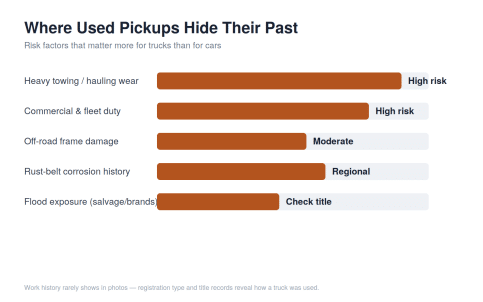
The risks that matter on a used pickup are the ones tied to how it worked, not how far it drove.
Read the registration, not the ad
The single most useful line in a truck’s history report is the registration type. Commercial registration means the truck was a tool: daily towing, payload at or over the limit, and maintenance done on whatever schedule kept it earning. Fleet trucks also tend to have many drivers and zero mechanical sympathy. None of that makes a truck unbuyable — work trucks are often maintained on strict schedules — but it makes the asking price negotiable and the transmission service records mandatory.
Ownership count tells a story too. Work trucks get passed down the food chain as they wear: the contractor sells to the landscaper, the landscaper sells to the guy who needs a firewood truck. Four owners in six years on a three-quarter-ton diesel is a truck that’s been used up and moved along, whatever the odometer says.
Flood trucks and title games
Pickups are overrepresented in flood totals — they’re everywhere in hurricane states, and they’re worth enough that rebuilders bother with them. After every major flood event, branded trucks fan out across the country and titles get washed through states with looser branding rules. The defense is the multi-state title chain in the history report: a Texas title that jumps to a title-washing-friendly state and back within months of a named hurricane is a pattern, not a coincidence. Check the flood-damage history specifically, and cross-check title issue dates against storm seasons.
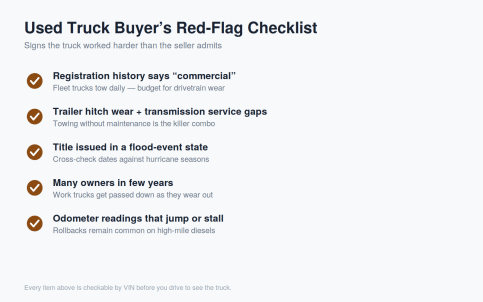
Every red flag on this list is checkable by VIN — before you waste a Saturday driving out to see the truck.
The diesel odometer problem
Odometer fraud never went away; it went digital. High-mileage diesels are prime candidates because the engines outlast the market’s tolerance for big numbers — a 350,000-mile Duramax runs fine, but it sells a lot faster wearing 180,000. Mileage gets recorded at every title transfer, emissions check, and auction pass, so a rollback shows up in the records as a number that drops or freezes. It’s one of the easiest frauds to catch on paper and one of the hardest to catch from the driver’s seat.
While you’re in the records, check the truck’s configuration against the ad. Trim inflation is rampant in truck listings — payload packages, towing packages, axle ratios, and bed lengths get described from memory rather than the build sheet, and the difference between a 3.31 and a 3.73 rear end is the difference between a truck that tows your camper and one that wheezes at it. The VIN decode and original window sticker settle the spec before you settle the price.
Recalls: free money you’re leaving on the table
Trucks carry some of the highest open-recall rates on the road, partly because work trucks skip dealer visits. Recall repairs are free at any franchised dealer regardless of ownership, so an open recall is a to-do item, not a dealbreaker — but an ignored recall list is also a proxy for how the truck was maintained generally. Pull the list by VIN and, given recent cases of recall repairs being marked complete but never performed, treat “already fixed” as worth verifying too.
Plow trucks, farm trucks, and the rust question
Geography is history too. A truck’s registration states tell you whether it lived its life in the rust belt, and a snow-state truck that changed hands every few winters fits the profile of a plow rig — a duty cycle that hammers front suspensions, transfer cases, and frames with salt exposure the seller’s photos won’t show. Farm-registered trucks are their own category: often low-mileage but hard-mileage, with years of short trips, heavy loads, and dirt-road abuse compressed into deceptively small odometer numbers. None of it disqualifies a truck. All of it changes what your inspection should target and what the price should be.
The same logic applies in reverse when you’re the seller. A documented one-owner, personal-use, southern-state truck with a clean chain is worth real money over book, and handing a buyer the report unprompted is the fastest credibility move in the game. Trucks trade on trust more than any other vehicle class because the failure modes are expensive; verifiable history is how you monetize having been the good owner.
The order of operations
Run the report first — it costs less than the fuel to go see a bad truck. If the records are clean, then do the physical inspection with the report in hand: documented towing history sends you straight to the transmission fluid, the rear axle, and the frame around the hitch. If you’re deciding which report provider to use, comparison resources like Best Vehicle History Report rank the major services on coverage and price, including how well each handles auction and salvage data — the categories that matter most for trucks.
There are plenty of honest used pickups out there, including honest work trucks priced like work trucks. The records are how you tell them apart from the ones that are just dressed for the interview.