A 4WD asks more of a mechanic than a hatchback ever will. Load one up with a canopy, a second battery, a bar and a set of all-terrains, then drag it down a corrugated track for a fortnight, and you have a vehicle operating well outside what the average suburban workshop sees on a Tuesday morning.
Plenty of mechanics are good with cars. Fewer properly understand 4WDs. The gap between the two tends to reveal itself at the worst possible moment, usually a long way from phone reception. Here is what to look for before you hand over the keys.
Why does a 4WD need a different kind of mechanic?
Touring rigs carry weight, and weight changes everything. Suspension, brakes, bearings, cooling and driveline all work harder than the factory ever intended.
Then there is the gear bolted to it. Dual batteries, DC-DC chargers, solar panels, brake controllers, driving lights, fridges and winches. At some point the vehicle stops being a factory product and becomes a new system, and systems fail at the joins.
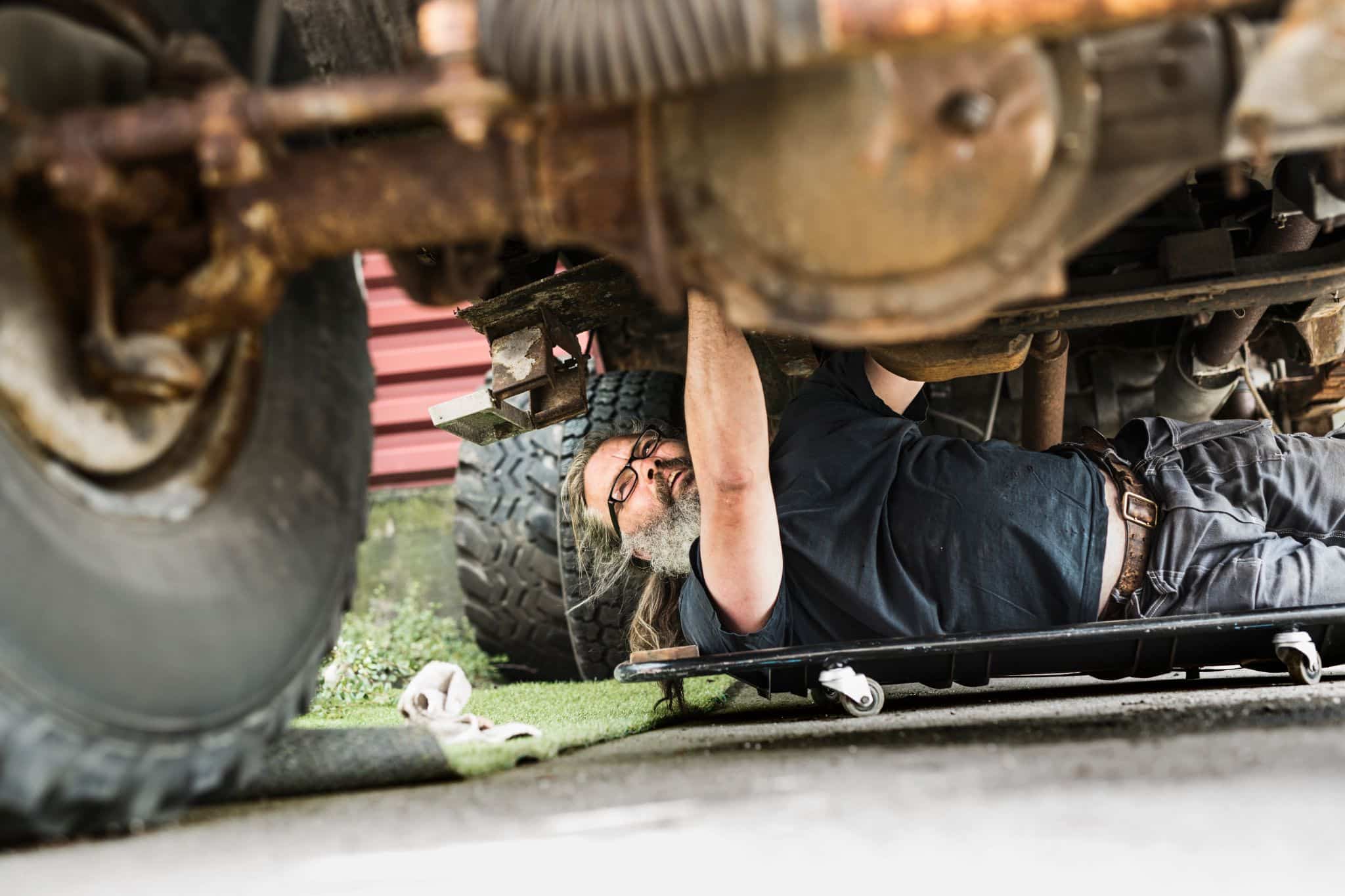
A workshop that only sees unmodified commuters will service what the manual lists and miss the rest. A 4WD specialist knows what actually strands people: wheel bearings, diff breathers after a water crossing, a chafed loom running behind a bull bar, corrosion in the spots where mud sits for months.
What qualifications should you be checking?
Start with the basics. Any qualified mechanic will hold a Certificate III in a relevant automotive trade. Auto electrical is a separate trade altogether, though, and a good mechanic is not automatically a good auto electrician. On a modern 4WD with a stack of accessories wired through it, you want both skill sets under the one roof.
Air conditioning is another one owners rarely think to ask about. Handling refrigerant requires a licence, and newer vehicles run R1234yf rather than the older R134a. They are not interchangeable, and the equipment differs.
Roadworthy work is tighter again. In Victoria, only a Licensed Vehicle Tester at an approved facility can issue a certificate of roadworthiness. The examining mechanic must hold a Certificate III or seven years of verifiable trade experience, complete the accreditation training, and personally road test the vehicle they have inspected. A workshop offering roadworthy certification alongside its servicing saves you a second booking, and it is a fair signal the place is held to a regulated standard.
Do they actually know the modification rules?
This is where owners get caught out. Modifying a 4WD is not a free-for-all, and the rules are stricter than the aftermarket catalogue would have you believe.
Victoria works off VSI 8, the state’s guide to vehicle modification, alongside the national VSB14 code. For raising an off-road 4WD, VSI 8 allows up to 75mm of total lift, counting suspension and tyres together, or a third of suspension travel with limits on tyre diameter. Push beyond that, and you are into engineering certification. The general national limit sits lower at 50mm, which is where most of the confusion begins.
Bull bars carry their own requirements under VSI 1 and Regulation 35 of the Road Safety (Vehicles) Regulations 2021. Exposed sections must be radiused and deburred, sharp protrusions are out, and the forward offset cannot exceed 75mm or 9 degrees. Airbag compatibility matters too.
A mechanic who waves these questions away is a liability. Non-compliant modifications can fail a roadworthy, and more seriously, they hand an insurer an argument to run after a crash. Ask directly how the workshop handles compliance, and whether they will tell you when a job genuinely needs an engineer’s certificate.
Can they handle the 12-volt side of things?
Most touring headaches are electrical rather than mechanical. A dead auxiliary battery. A DC-DC charger wired to the wrong feed. Lights that flicker every time the corrugations start.
Ask which brands the workshop installs and whether they are an approved supplier or fitter. Companies such as Redarc and Dobinsons work through accredited installer networks, which means someone there has been trained on the product rather than working it out from a wiring diagram.
Then ask to see photographs of previous fit-outs. Tidy loom routing, proper fusing, labelled circuits and sensible earth points will tell you more about a workshop than any amount of advertising.
Will servicing there affect your new car warranty?
Short answer, no. This myth costs people real money every year.
Under Australian Consumer Law, you are not required to service at a dealership to keep your manufacturer warranty intact. An independent workshop can carry out logbook servicing and stamp the book, so long as the mechanic is appropriately qualified, the parts suit the vehicle, and the work follows the manufacturer’s specifications and service intervals. Parts do not have to be genuine, only fit for purpose.
If a dealer knocks back a warranty claim purely because you serviced elsewhere, that is not on. The ACCC takes reports on 1300 302 502.
What should you ask before booking?
A few questions worth asking:
- Do you regularly work on modified and loaded 4WDs, or mostly standard vehicles?
- Are you a Licensed Vehicle Tester?
- Is your auto electrical work done in-house by a licensed auto electrician?
- Will the quote be in writing, including likely extras?
- What happens if you find something else once it is apart?
The right workshop will ask where you are taking the vehicle before it tells you what the job will cost. Touring loads, water crossings and corrugations all change what needs checking, and a mechanic who understands that catches the small things before they turn into a recovery bill. Worth finding one now, while the diary is open and you are not ringing from the side of a track.