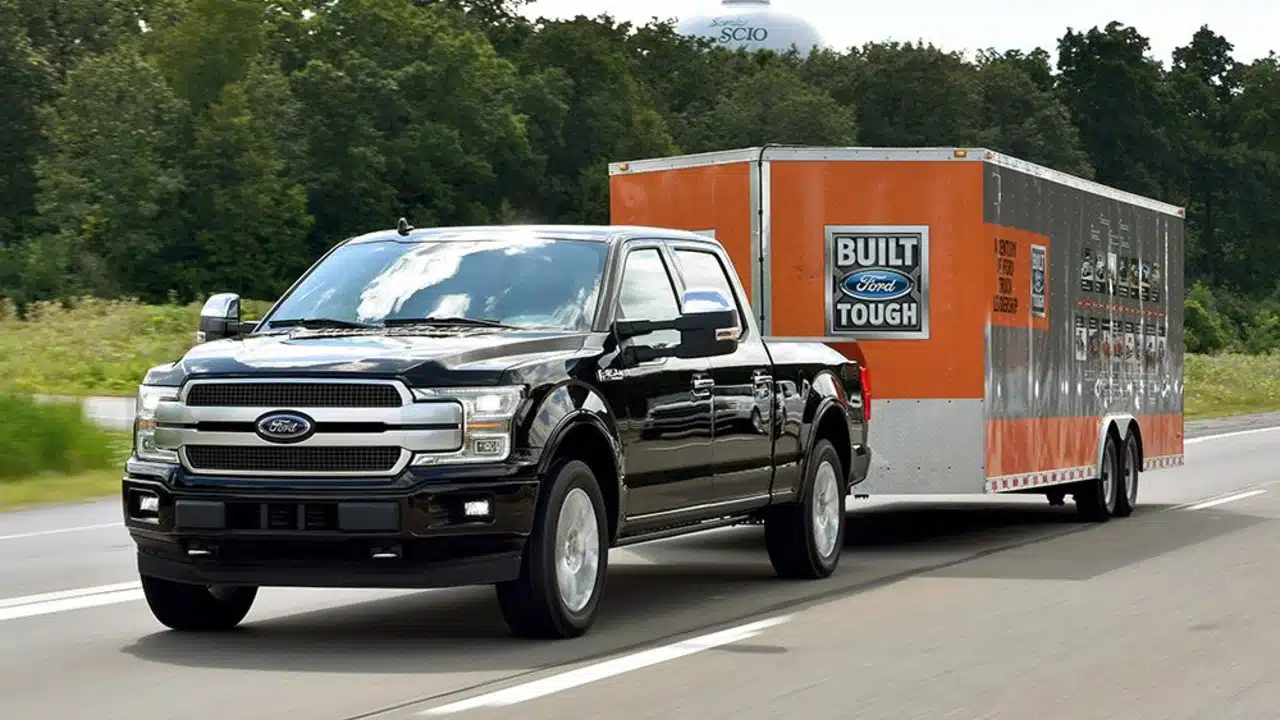
A federal judge refused to let owners of 2017–2020 Ford F-150s with the 10R80 automatic pursue their claims as four state classes. That’s a win for Ford in the F-150 10-speed lawsuit, but the September 14 ruling didn’t dismiss the named owners’ individual claims or say the trucks shifted fine.
The plaintiffs allege the transmission seals leak, leading to harsh shifting. However, Ford revealed in court that engineers identified a leak with their Z-lock seals and swapped to solid seals before the trucks went on sale. This significant reveal made it harder for the owners to use early test results to show that the production trucks all shared the same problem.
Experts from both parties also debated other issues with the transmission.
Which F-150s were in the lawsuit, and why Ford built the 10-speed
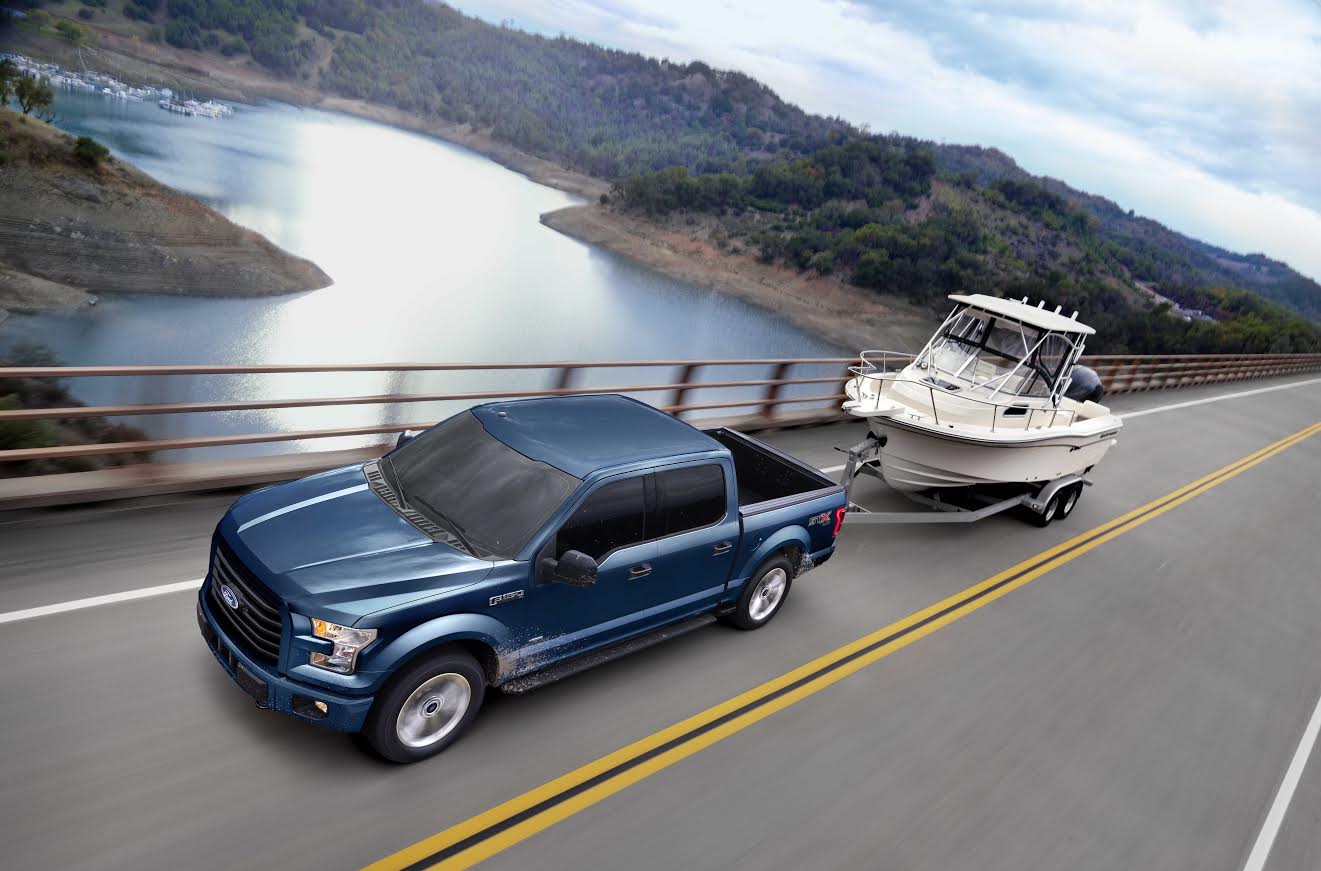
Ford sold F-150s with two different automatics in those years. In Ford’s 2017 brochure, the 2.7-liter EcoBoost, non-turbo 3.5-liter V6 and 5.0-liter V8 all used a six-speed. The redesigned 3.5-liter EcoBoost got the 10-speed, as did the Raptor’s high-output version. Ford expanded the 10-speed lineup for 2018, but the base 3.3-liter V6 stayed with the six-speed through 2020. The six-speed trucks weren’t part of this case because the owners alleged a defect specific to the 10R80.
The lawsuit was filed in 2019. By the time Judge Jeffrey I. Cummings ruled on class certification on September 14, 2026, the owners were asking to represent people who owned or leased 2017–2020 F-150s with the 10R80 in four states: California, Illinois, Massachusetts and New York. Even trucks with the 10-speed were outside the proposed classes if the model year or state didn’t match. The plaintiffs estimated the four proposed classes covered 208,639 trucks. That’s not a count of complaints.
Ford started design work in 2011 and launched the 10R80 in November 2016. It came out of a joint development program with General Motors; this case concerns Ford’s 10R80, not GM’s 10L80.
Why add four gears? The court order says Ford aimed to improve fuel economy and reduce greenhouse-gas emissions compared with the outgoing six-speed 6R80. In its 2017 F-150 launch materials, Ford said it designed the closer gear spacing to keep the engine in a more useful part of its power range and improve efficiency and drivability. Ford paired the new transmission with a redesigned 3.5-liter EcoBoost V6 at launch, so any gain from that package wasn’t the transmission’s alone.
What F-150 owners told the court

Five owners asked to represent the proposed classes. What they described in depositions and an NHTSA complaint cited in the ruling ranged from a clunk in the driveway to a loss of acceleration on the highway.
Jason Steen testified that his 2017 F-150 XLT with the 3.5-liter EcoBoost could rattle at about 25 mph and “slam into gear” on the shift from fourth to fifth. He also described the truck lunging forward and feeling jerky both when he sped up and when he slowed down.
Bryan Smith described a different sensation in his 2018 XLT. As he put it in the earlier court record, “I can be in the 10th gear while driving 65 mph, then transmission slips.” He said the truck would slow before picking up speed again when the gear reengaged. He later testified that it could slip out of gear while he was passing on the highway.
For Susan Heller, one problem showed up at a stop. In her NHTSA complaint, she wrote that the “transmission is not engaging right away” when she tried to pull away from a light or a stop sign. She also reported taking the truck to the dealer twice in 2018 without a diagnosis. In her deposition, she described the startup clunk separately and said it had lately been happening maybe twice a year and didn’t interfere with her driving.
Michael Barcelona testified that he heard “a metal sound” from the rear of his truck. He recalled clunks while accelerating and even after coming to a stop. Stanislaw Zielinski described watching the revs climb without the truck gaining speed before it jerked and started pulling again. He also recalled a whine on shifts, a rattle when he lifted off the accelerator and one loss of power.
Those accounts explain what owners meant when they talked about rough shifts or slipping. The harder question for the court was whether the same mechanical problem could explain those different experiences across all four proposed classes.
Ford says it put more than 4 million test miles on the 10-speed
Ford told the court it ran more than 800 computer-aided engineering models and logged more than 4 million miles of testing before production. More gears also meant more possible shifts: internal Ford material in the record counted 90 versus 30 for the old six-speed.
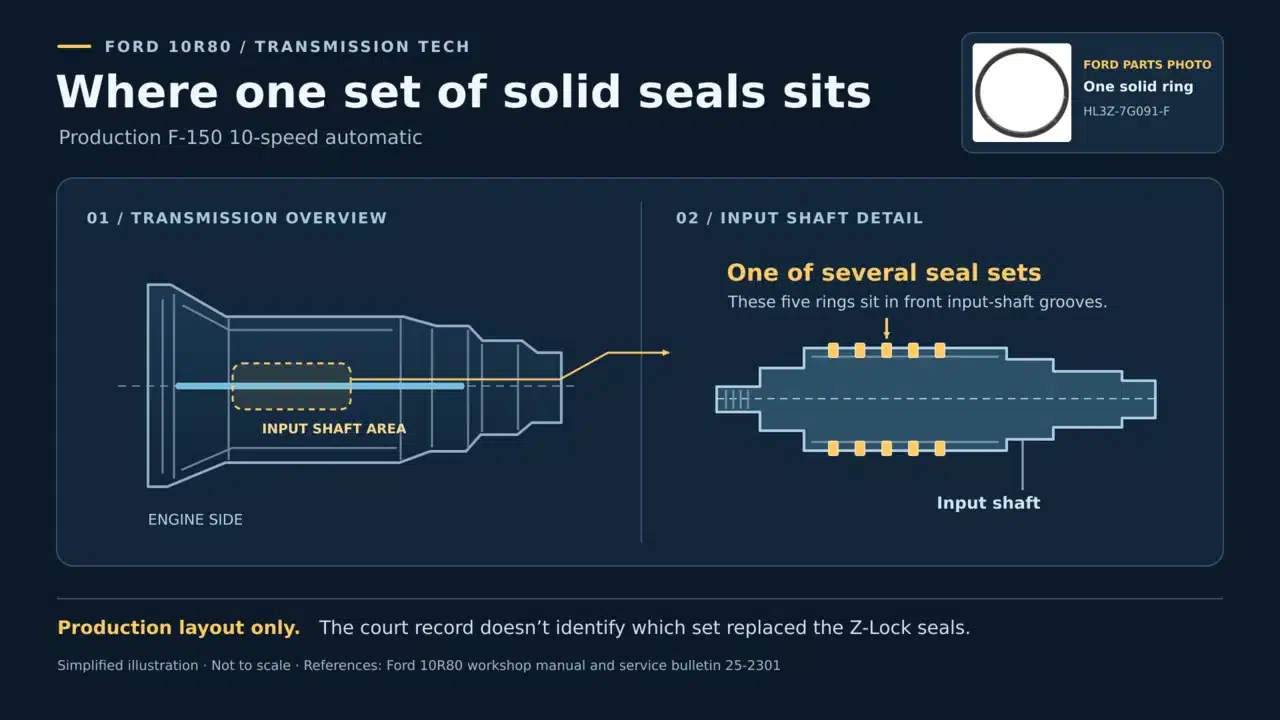
The extra testing turned up a problem. In December 2015, Ford found an unacceptable amount of leakage in very cold conditions with an interlocking prototype seal called the Z-Lock. Ford switched to solid seals before production. Buzz Riley, who led Ford’s seal team, testified that the replacements had “virtually zero” leakage across the temperatures and speeds tested. The September order says none of the trucks in the proposed classes had the prototype seals. So the early test results tell us Ford caught a problem. They don’t, by themselves, establish what caused reported harsh shifts after launch.
The owners’ engineer suspected the production transmission could still lose pressure

Mechanical engineer Michael Stapleford proposed a different path to leakage in the production unit. If the mainshaft vibrated or flexed, he reasoned, that movement could let fluid leak past even the solid seals. Hydraulic pressure applies the clutches that engage each gear; if pressure drops or arrives at the wrong time, a shift can feel late or abrupt. Stapleford testified that “vibration is causing the leakage,” according to the March 2025 technical-expert order.
Stapleford drove three of the five named owners’ trucks, using cameras and Ford’s diagnostic system to collect data. But he didn’t directly measure the suspected vibration or test the transmissions for that leakage. He also relied on a YouTube teardown from a vehicle whose year and mileage he didn’t know. The judge allowed Stapleford’s core theory into evidence, then gave it little weight when deciding whether it explained the complaints across the proposed classes. Getting an opinion into evidence and proving it are two different things.
The owners pointed to 10 Ford service bulletins. The judge’s discussion of those bulletins shows why that evidence cuts both ways. Ford issued repair instructions, but the judge noted that the bulletins pointed to several possible causes: adaptive software, solenoid calibration, sticking valves in the valve body and a sleeve that can shift inside the CDF clutch cylinder. Ford bulletin 25-2301, which covers some 2017–2020 F-150s, focuses on that last issue. It tells technicians to verify a hydraulic leak before replacing parts. Stapleford discussed a possible link between sleeve movement and vibration, but the bulletin doesn’t establish vibration as a common cause. It isn’t a recall.
What the judge did and didn’t decide

Judge Cummings found that the class-action waiver in Ford’s new-vehicle warranty barred the owners from bringing the warranty claims as a group. For the remaining claims, the owners didn’t show that a common underlying cause tied the trucks together as required for class certification. That’s a different question from whether any one owner had a bad transmission.
The judge put the distinction plainly: the order isn’t “a declaration that Ford’s 10R80 transmission is free of problems related to harsh shifting.” The September ruling also didn’t decide the merits of the named owners’ individual claims. Ford’s attorneys say the Seventh Circuit declined to allow an immediate appeal of the class-certification ruling on November 2.
If you’re shopping for a used F-150, I’d still look at how that specific truck shifts cold and warm and ask for its service records. For later trucks, see our 2021–2026 Ford F-150 transmission known problems guide. Those model years weren’t part of this ruling.