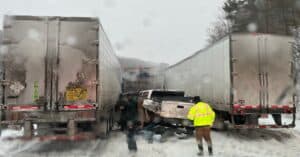
If you drive a pickup, you already understand something most sedan drivers don’t: physics doesn’t care about your intentions. A loaded three-quarter-ton truck stops differently, corners differently, and hits differently than a Civic. Most of the time that mass is working for you. In a crash, it changes everything about what happens next — and if the other vehicle is a full-size commercial rig, you’re now dealing with a machine that outweighs you many times over and a company that treats crashes as a routine business event.
Nobody plans for this. But the hour after a collision is the one that matters most, and the difference between people who come out of it okay and people who spend a year fighting an insurer — or, in a serious crash, calling a truck accident lawyer — usually comes down to what they did in those first sixty minutes. Here’s the practical version, in order.
First: get safe and get checked, even if you feel fine
Move to safety if you can. Turn on your hazards, and if you carry reflective triangles or flares — and you should — set them out. A disabled vehicle in a live lane is how a bad situation becomes a worse one.
Then, before anything else, deal with injuries. This matters legally as well as medically: adrenaline masks pain, and the classic truck-crash pattern is the driver who waves off the ambulance, wakes up the next morning barely able to move, and then spends months fighting an insurer who argues the injury “wasn’t that serious” because there’s no same-day medical record. If your body took a hit, get evaluated. The paper trail that protects you starts with that first medical visit.
The physics point is not abstract here. As Pickup Truck +SUV Talk has covered in looking at why pickups can face different crash risks, a truck’s height and mass produce collision dynamics that differ from a passenger car’s — which can mean injuries that don’t show up until the swelling sets in. Get checked.
Second: call the police, and let the report be the record
Unless the crash is genuinely minor, call law enforcement. In most states an officer will respond and investigate, and that official crash report becomes the anchor document for everything that follows — it lists the drivers, the vehicles, the carrier information if a commercial truck was involved, witnesses, road and weather conditions, and any citations issued.
Say what happened, factually. Do not speculate, do not guess at fault, and above all do not apologize reflexively. “I’m sorry” at a crash scene is human, but in a state with the wrong fault rules it can be read as an admission. Stick to what you actually know.
Third: document everything, because the truck’s evidence is about to disappear
This is the part almost nobody knows, and it’s the single most valuable thing in this article.
A commercial truck is rolling instrumentation. It carries an event data recorder — a “black box” — that logs speed, braking, and throttle in the seconds before impact, and an Electronic Logging Device that records exactly how many hours the driver had been behind the wheel. If that driver was over the federal limit, or the truck was speeding, or the brakes were never touched, the proof exists right now, inside that truck.
The problem: that data belongs to the trucking company, and it can be legally overwritten in the ordinary course of business — sometimes within months — unless someone with legal authority formally demands it be preserved. This is why serious truck cases are won or lost in the first weeks. So while you’re at the scene, build your own record with the one tool you’re guaranteed to have: your phone.
- Photograph everything — both vehicles from multiple angles, the full scene, skid marks, debris, road conditions, and the damage to each vehicle.
- Get the truck’s details: the DOT number and company name on the door, the license plates, the trailer.
- Photograph the driver’s license and insurance, and the driver qualification info if offered.
- Get names and numbers for every witness. They scatter fast, and a neutral witness is worth a great deal later.
You are documenting a scene that will be cleared within the hour and evidence that may not survive the month.
Fourth: understand who you’re actually dealing with
When your pickup tangles with a commercial truck, you are not in a dispute with the driver. You are in a dispute with a company — often several: the carrier, the truck’s owner, the outfit that loaded the cargo, sometimes a freight broker. Many of them dispatch a rapid-response team to serious crashes within hours, whose job is to start building the company’s version of events — and, frequently, to start building a case that the crash was partly your fault.
Why partly your fault? Because of how the money works. Many states, including South Carolina, use a fault rule where you can only recover if you’re 50% or less to blame — and at 51%, you get nothing. Every percentage point the company can pin on you shrinks what it pays, and pushing you over the line erases your claim entirely. That’s the reason for the friendly adjuster who calls two days later asking for a “quick recorded statement” while you’re still on painkillers. You are under no obligation to give one, and you generally shouldn’t before getting advice.
Fifth: know the clock — both of them
There are two deadlines, and people focus on the wrong one.
The obvious deadline is the statute of limitations — three years in South Carolina, but as little as two in other states. Miss it and your case is over regardless of merit.
The deadline that actually decides most cases is invisible: the retention window on the truck’s black-box and ELD data, which can run out in months. This is why getting legal advice early isn’t about being litigious — it’s the only way that perishable evidence gets formally preserved before the carrier’s ordinary operations erase it. A preservation demand sent in week one protects the proof. Sent in month six, it arrives to find the data already gone.
The short version to keep in your glovebox
- Safety, then medical — get checked even if you feel fine; the adrenaline is lying to you.
- Call the police, state facts, don’t apologize or guess at fault.
- Photograph everything, get the truck’s DOT number and company name, collect witnesses.
- Say nothing to the company’s adjuster beyond the basics — especially no recorded statement — until you’ve had advice.
- Move fast on preservation. The evidence that proves your case lives in the other guy’s truck and won’t wait for you.
You bought a truck because it’s capable and built to handle what the road throws at it. Handle the aftermath of a crash the same way — deliberately, and with a plan — and you protect yourself long after the tow truck has left.