How to balance road comfort, trail traction, load capacity and winter capability before choosing your next set.
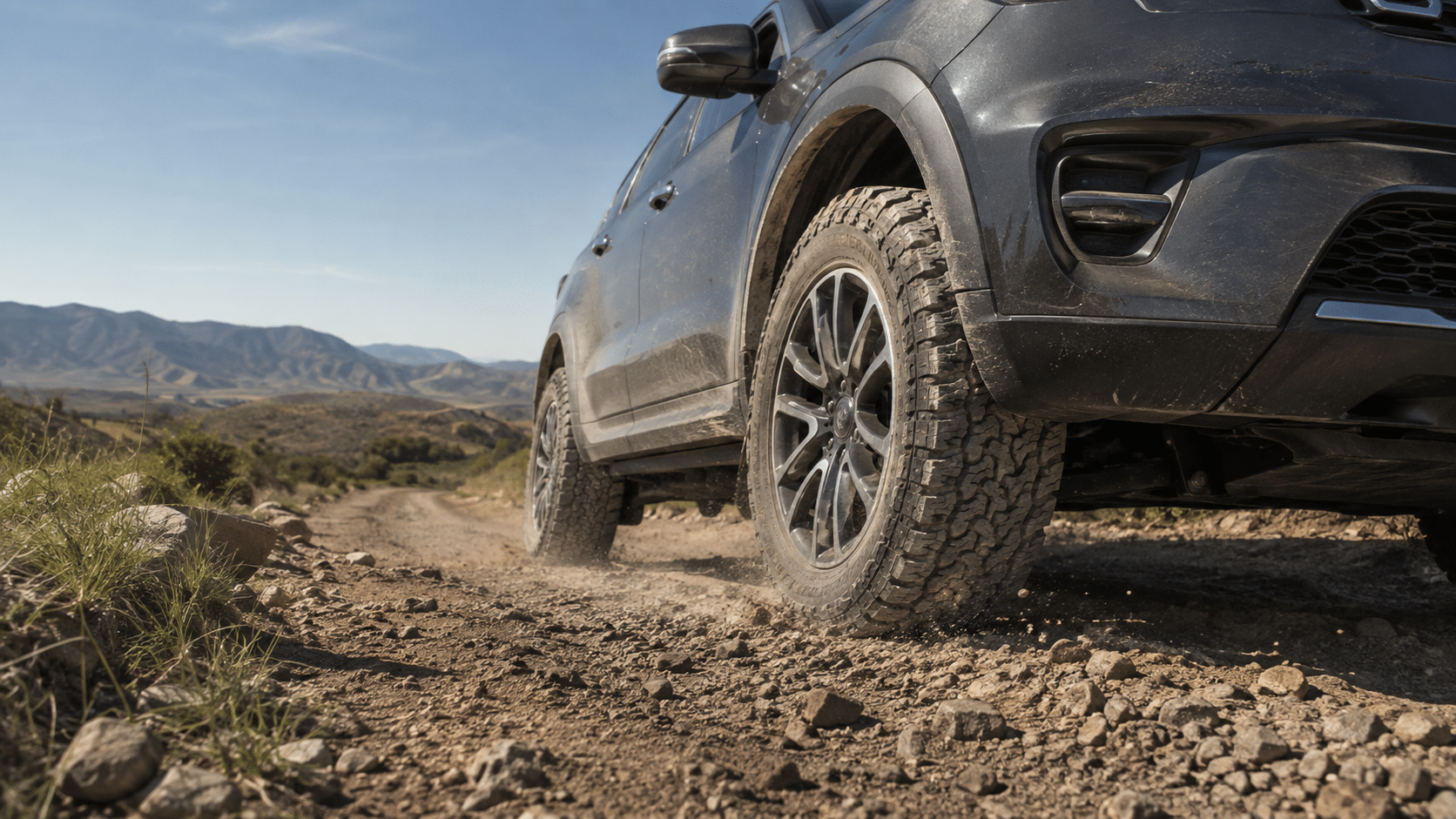
All-terrain tires are designed for drivers who need more capability on gravel, dirt, sand and uneven ground without moving all the way to a dedicated mud tire. The best choice is not automatically the tire with the deepest tread or most aggressive sidewall. It is the tire that matches how often the vehicle leaves pavement, the surfaces it encounters, its load requirements and the amount of road comfort the driver is willing to trade.
This guide explains the main all-terrain categories, the markings that matter, the compromises that product photos rarely show and the questions to answer before buying a set.
What are all-terrain tires?
All-terrain tires sit between highway tires and dedicated off-road tires. Their tread usually has larger blocks, wider voids and more open shoulders than a highway pattern. Those features can help the tire find traction and clear loose material on unpaved surfaces. At the same time, an all-terrain design normally keeps enough continuous tread contact to remain usable for daily road driving.
The category covers a wide range of products. Some are essentially touring tires with added gravel-road capability. Others use heavy light-truck construction, aggressive shoulders and reinforced sidewalls for more demanding trails. Treating every all-terrain tire as interchangeable is one of the biggest buying mistakes.
Who should buy all-terrain tires?
All-terrain tires make sense when a pickup or SUV regularly travels beyond maintained pavement but still spends meaningful time on public roads. Common use cases include:
- Gravel roads, farm access roads and construction sites
- Camping, overlanding and trail access
- Loose dirt, shallow sand and moderate mud
- Work vehicles that encounter damaged or unsealed roads
- Drivers who need one tire for mixed paved and unpaved use
They are usually unnecessary for a vehicle that remains almost entirely on paved roads. A highway or touring tire will generally offer better ride comfort, lower noise and potentially better efficiency. At the other extreme, a serious mud-terrain tire may be more appropriate when deep mud, rock crawling or highly technical terrain is the vehicle’s primary job.
The four main off-road tire categories
On-road all-terrain
This is the road-biased end of the category. The tread is moderately open, but the pattern retains more rubber in contact with the road. These tires suit drivers who mainly commute or tour and occasionally use gravel, grass, hard-packed dirt or maintained trails. They usually provide the best comfort and wet-road behavior among all-terrain options, but less traction on deep or unstable surfaces.
Off-road all-terrain
A conventional off-road all-terrain tire uses wider tread voids, more pronounced shoulders and stronger protection against loose terrain. It is the most balanced option for drivers who divide their time between highways and genuine trail use. The trade-offs may include more road noise, added weight and less precise wet or emergency handling than a road-focused tire.
Rugged-terrain
Rugged-terrain tires bridge the gap between all-terrain and mud-terrain designs. They usually feature aggressive sidewalls and large tread blocks, giving the vehicle a more capable appearance and useful loose-surface traction. However, the extra aggression can bring higher noise, firmer ride quality and weaker wet-road performance. Rugged appearance does not guarantee better traction on every off-road surface.
Mud-terrain
Mud-terrain tires use very open tread patterns intended to dig and clear thick mud and loose soil. They are a specialist choice, not the natural upgrade from every all-terrain tire. Drivers should expect a greater compromise in road noise, comfort, wet behavior, tread life or efficiency. If the truck spends most of its life on pavement, a mud-terrain design is usually excessive.
Why more aggressive is not always better
Recent testing reinforces the importance of matching the tire category to the surface. Tire Rack’s December 2025 off-road evaluation compared four different off-road categories on the same Toyota Tacoma using LT265/70R17 Load Range E tires. The off-road all-terrain tire was the testers’ most balanced choice across the loose surfaces used. The road-focused all-terrain model performed well on firmer ground but struggled more as the terrain became loose and uneven.
The same test also found that simply choosing a more aggressive category did not guarantee more traction. Surface type, tread shape, compound, construction and the way the tire interacted with the vehicle all mattered. The test was subjective and limited to specific terrain, but its central lesson is broadly useful: buy for the ground you actually drive on, not for the toughest-looking sidewall.
Road testing reveals the opposite side of the compromise. In a 2025 Tire Rack comparison of several all-terrain categories in 265/70R17, some of the most aggressive designs gave up wet or winter traction despite looking more capable. All-terrain buyers should therefore check wet braking, emergency handling, road noise and snow results separately from off-road performance.
Manufacturer development context can add useful background, but it should not be confused with an independent product test. In its current review of 26 years in motorsport, Giti says experience from its 4×4 Extreme Series and other demanding competitions has contributed to all-terrain and SUV tire development. That helps explain the engineering role of off-road testing, while independent comparisons remain the better evidence for purchase decisions.
How to choose all terrain tires
1. Calculate your real on-road and off-road use
Estimate how the vehicle is actually used, not how you hope to use it. A truck driven 90 percent on pavement should normally start with an on-road or mild all-terrain tire. A vehicle that regularly tackles loose dirt, rocks and rutted trails may justify a more aggressive off-road design. If deep mud is rare, do not let one annual trip dictate an uncomfortable tire for the other eleven months.
2. Identify the most difficult regular surface
Different tread features solve different problems. Open voids can help evacuate mud and loose material. Biting edges and sipes can help on wet roads and snow. Strong shoulders and sidewall features may improve protection or traction in ruts. Hard-packed gravel, sharp rock, beach sand and clay mud do not demand the same tire, so a vague label such as ‘off-road capable’ is not enough.
3. Match the original size and load requirement
Start with the tire and loading label on the driver’s door pillar and the owner’s manual. NHTSA advises using the original tire size or another size recommended by the vehicle manufacturer. The replacement must also provide appropriate load capacity and speed capability for the vehicle and its use.
Do not assume an LT tire or a higher load range is automatically better. LT construction can provide additional load capacity and durability for appropriate applications, but it can also add weight and stiffness. A heavy Load Range E tire may be unnecessary on a lightly loaded crossover and could make the ride harsher. Towing and payload requirements should be checked against the vehicle documentation and exact tire specification, preferably with a qualified installer.
4. Understand P-metric, LT and flotation sizing
P-metric and hard-metric sizes are common on passenger-focused SUVs and light trucks. LT-metric tires are designed for light-truck service where additional load capacity may be required. Flotation sizes, such as 35×12.50R17LT, describe the approximate overall diameter and width in inches. Each system carries different load and inflation information. Never substitute one type for another based only on physical dimensions.
5. Check M+S and 3PMSF markings
M+S indicates that the tire is intended for limited mud and snow service. It should not be treated as proof of strong winter performance. The three-peak mountain snowflake symbol, or 3PMSF, indicates that the tire has met a standardized severe-snow traction threshold. It provides more meaningful snow evidence than M+S alone, but it does not measure every aspect of braking, cornering or ice performance and does not make every all-terrain tire equivalent to a dedicated winter tire.
6. Compare road behavior, not just trail claims
Look for independent results covering wet braking, emergency lane changes, noise, ride comfort, snow and ice. A tire can feel predictable yet still record a long stopping distance. Conversely, a capable road tire may have limited traction in deep sand or loose rock. No single score captures both environments.
7. Consider weight, fuel use and steering
Large all-terrain tires can increase rotating mass and rolling resistance. Depending on the vehicle and fitment, that may affect acceleration, braking feel, steering response and fuel or electric range. Oversizing can also create clearance problems and affect speedometer readings, gearing and driver-assistance calibration. Any change from the original size should be assessed as a vehicle-system modification, not merely a styling choice.
8. Compare warranty terms carefully
A mileage warranty can help compare ownership value, but it is conditional. Coverage may differ between P-metric, LT and flotation sizes. Rotation records, correct inflation, alignment and proof of purchase may affect eligibility. A warranty is not an independent performance rating and does not guarantee that every vehicle will reach the stated mileage.
How GT Radial’s all-terrain range fits different drivers
GT Radial’s global range illustrates why buyers should choose by intended application rather than assuming every all-terrain tire serves the same driver. Availability, sizes, markings and warranty coverage can vary by market, so the exact regional specification still needs to be confirmed before purchase.
ADVENTURO AT3: balanced daily and trail use
The GT Radial ADVENTURO AT3 is designed for light trucks and SUVs that need off-road capability without abandoning on-road comfort. GT Radial highlights an enhanced tread compound, interlocking tread blocks, an S-shaped center rib, chamfered 3D grooves and five-pitch pattern technology. Those features are intended to support wet and dry grip, stability on loose surfaces, self-cleaning and reduced road noise.
ADVENTURO A/T: a straightforward mixed-surface option
The ADVENTURO A/T is positioned as a balanced all-terrain tire for light trucks and SUVs. Its official global product information emphasizes tough tread blocks, shoulder-to-shoulder siping, traction, cornering stability and durability for drivers who move between highways and rougher routes. Buyers should still compare independent wet, winter and noise results for the relevant size.
SAVERO A/T PRO: SUV and 4×4 versatility
The SAVERO A/T PRO is aimed at SUV and 4×4 drivers seeking on-road comfort alongside off-road capability. GT Radial lists a Z-shaped center rib with 3D-edge slopes, large shoulder blocks with sipes and noise-reduction grooves among its design features. The product description supports its intended use, but it does not replace comparative braking, handling or winter testing.
These official descriptions establish intended application and published design features, not a head-to-head performance ranking. The correct choice still depends on approved fitment, vehicle requirements, local product specifications and independent evidence relevant to the driver’s conditions.
All-terrain tire maintenance
Use the vehicle’s cold-pressure specification
Set normal road pressure from the vehicle’s tire and loading label or owner’s manual, not the maximum pressure molded on the tire sidewall. Check pressure when the tires are cold and account for loads as directed by the vehicle and tire documentation.
Treat airing down as a controlled off-road procedure
Reducing pressure can enlarge the contact patch and improve compliance on some off-road surfaces, but there is no universal safe trail pressure. Vehicle weight, tire construction, wheel width, speed and terrain all matter. Excessive deflation can cause heat, sidewall damage or loss of the bead seal. Air down only with suitable guidance and equipment, drive slowly, inspect the tires and restore correct road pressure before returning to normal-speed travel.
Rotate and inspect regularly
Aggressive tread can reveal irregular wear quickly. Follow the vehicle and tire manufacturer’s rotation instructions. NHTSA notes that, where the vehicle manufacturer recommends rotation, a 5,000 to 8,000-mile interval may be appropriate, or sooner if uneven wear appears. Inspect for cuts, bulges, embedded objects, chunking and uneven shoulders after demanding trail use.
Do not wait for a legal minimum to assess capability
A tire may remain legally usable while its wet, snow or off-road performance has already declined. Tread depth, damage, age, heat exposure and usage history all matter. Replace a tire when required by law or manufacturer guidance, or earlier when a qualified inspection shows that it can no longer perform the intended job.
Frequently asked questions
Are all-terrain tires good for daily driving?
Yes, if the tire is road-biased and correctly fitted. Expect some combination of additional noise, weight or reduced efficiency compared with a highway tire. More aggressive designs generally create larger compromises.
Are all-terrain tires good in rain?
Some perform very well, while others do not. Deep tread alone does not guarantee short wet braking or predictable emergency handling. Check independent wet testing for the exact model and relevant size.
Do all-terrain tires work in snow?
Many provide useful light-snow traction. For regular winter use, prioritize a model carrying the 3PMSF symbol and examine independent snow and ice results. In severe or persistent winter conditions, dedicated winter tires may still be the better tool.
How long do all-terrain tires last?
There is no universal lifespan. Tire construction, compound, vehicle weight, alignment, inflation, rotation, towing, road surface and driving style all affect wear. Compare the exact size’s warranty, but do not treat warranted mileage as guaranteed service life.
Can I install larger all-terrain tires without other changes?
Not safely by assumption. Larger tires may contact body or suspension components and can affect braking, gearing, speedometer accuracy and electronic systems. Confirm an approved fitment with the vehicle manufacturer or a qualified professional before changing size.
Final buying checklist
- Confirm the approved size, load capacity and speed rating.
- Estimate the real percentage of paved and unpaved driving.
- Identify the hardest surface encountered regularly.
- Choose the least aggressive category that meets that need.
- Check wet braking, emergency handling, noise and winter evidence.
- Look for 3PMSF when severe-snow traction matters.
- Compare P-metric, LT and flotation construction carefully.
- Review exact-size warranty terms and maintenance obligations.
- Avoid unapproved upsizing or load-range changes.
The best all terrain tires are not the most aggressive tires a vehicle can physically accept. They are the least compromised tires that provide the traction, load capacity and durability the driver genuinely needs. Start with fitment and regular terrain, verify the road-performance trade-offs, and choose the category that matches the vehicle’s real job.