Buying a surprise gift for a truck or SUV owner gets difficult as soon as you start looking at parts. The wheels need to fit. Suspension upgrades have to work with the vehicle’s existing setup. Even interior accessories can change by model year, trim, and cabin layout.
It gets trickier if they’ve already modified the vehicle. Something that fits a stock truck may no longer work, and even if it does, it might not be the part they wanted.
You can avoid all of that by making the gift about the truck or SUV they already have. Custom keychains can use details from the vehicle itself, meaning you won’t need to know which wheels, lights, or other upgrade they’ve been eyeing.
5 Custom Keychain Ideas for Truck and SUV Owners
The easiest way to get a design is to look at what’s already on their vehicle. Start with the details that make their truck or SUV feel like their own.
For example:
1. Recreate Their License Plate
A miniature version of their license plate is one of the simplest ideas because most of the design work is already done for you.
You could copy the actual plate number or use a vanity version based on the owner’s name or the nickname they have for their truck. If you’re working with a small keychain, keep the extra text to a minimum so the plate number remains easy to read.
2. Use Their Truck or SUV as the Design
For someone who has spent years building their vehicle, the vehicle itself can be the gift idea.
You don’t need to reproduce every grille line or suspension component. Pick the details that make their truck recognizable. That might be the overall body shape, oversized wheels, a roof rack, a rooftop tent, or a distinctive paint color.
A lifted 4×4, for example, will usually be recognizable from its stance and tires long before someone notices the smaller mechanical details.
3. Add Their Vehicle’s Name or Nickname
Plenty of owners name a project vehicle, classic pickup, off-road build, or daily driver.
That gives you another easy starting point. The name can become the main feature of the keychain, or you can pair it with a simple outline of the vehicle.
This works especially well when the nickname already has some history behind it. A keychain that says “Old Blue” alongside the outline of a restored blue pickup feels much more personal than a generic truck accessory.
4. Turn an Auto or Off-Road Club Logo Into a Keychain
Another option is to use something that represents the group they drive with. An off-road club or overlanding crew may already have a logo you can work from.
You can use that logo for a keychain for one member or order the same design for the whole group. If it includes a club name or location, make sure the text will still be easy to read at keychain size.
5. Make the Keychain Useful
Think about the keychain itself as well as the artwork.
Someone who regularly separates their truck key from their house keys might prefer a quick-release clasp or snap hook. Others may be perfectly happy with a basic split ring that stays attached all the time.
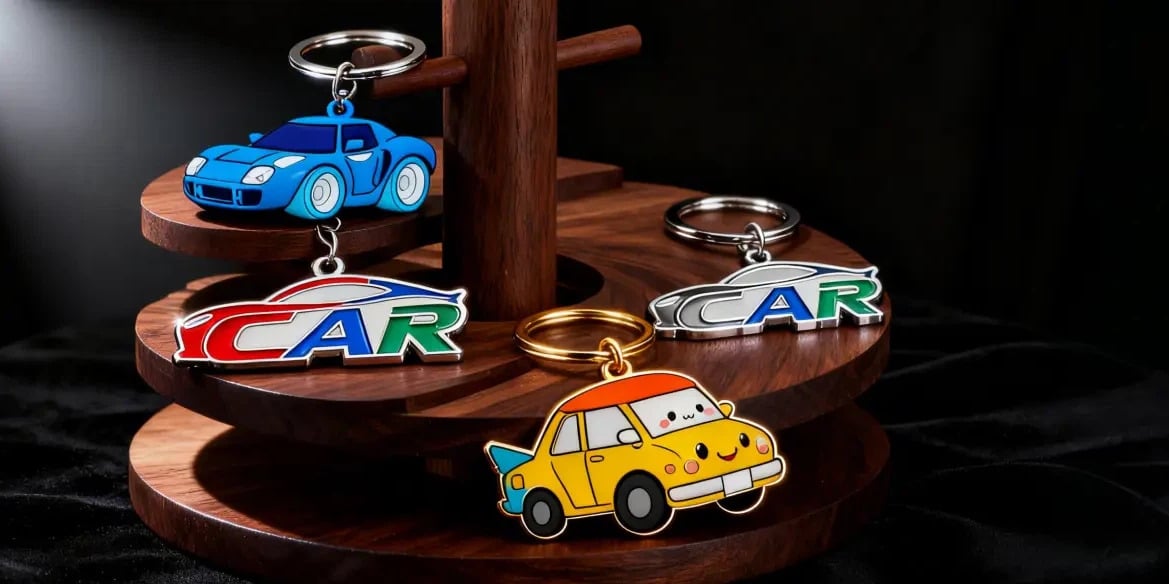
You can also choose a keychain with an extra function. GS-JJ offers options such as metal bottle-opener keychains and PVC keychains with NFC chips that can open a digital link when tapped with a compatible phone. If they won’t use the extra feature, skip it and stick with a simpler style.
Match the Keychain Material to the Design
Pick the artwork first, then choose a material that works with it. A detailed photo of a truck needs a different material than a simple club logo or vehicle outline.
Acrylic for photos and detailed artwork: Acrylic works well when you want to keep more of the detail from your original image. Think of a full-color truck illustration or an overlanding SUV with a detailed roof setup. Printed acrylic can handle details and color changes that traditional enamel cannot, making it a good option when you’re starting with a photo or detailed illustration of the vehicle.
Metal and enamel for a badge-style look. Metal and enamel suit clean lines and solid areas of color. A truck silhouette or vintage pickup logo can take on a look similar to an automotive badge. Enamel isn’t well suited to photos, shadows, or gradients, so detailed vehicle artwork will usually need to be simplified before production.
PVC for bold or dimensional designs. PVC works well for colorful custom shapes and designs with raised details. A 2D design uses flatter layers, whereas 3D PVC can give parts of the design a more rounded, raised appearance. That makes it useful for a stylized 4×4 where the tires and body are part of the physical shape.
Leather for a simpler look. Leather suits designs that don’t need a lot of color or fine artwork. A vehicle nickname, initials, club logo, or simple automotive symbol can be enough. It’s worth considering when the recipient would prefer something understated over a colorful, highly detailed picture of their truck.
Which Custom Keychains Are Easiest to Personalize Online?
The easiest keychain to personalize isn’t necessarily acrylic, metal, or PVC. It depends more on what you’re starting with.
Someone with nothing but an idea needs a very different design process from someone who already has a finished vector file.
If You Only Have an Idea
Here’s the good part: you don’t have to open a professional design program just to see what your idea might look like.
Some manufacturers now offer AI-assisted design tools. GS-JJ, for example, has an AI Keychain Generator where you type out a description of what you want and get a draft back. You can pick acrylic, metal, or PVC, then tweak the prompt to change things like the shape and colors.
This route works well if all you’ve got is something like “a lifted red pickup with big tires and a mountain behind it.” You don’t need finished artwork, just an idea to start with.
And if what it generates isn’t quite right, GS-JJ says its designers can adjust the artwork by hand at no extra design charge.
If You Have a Photo or Sketch
A photo can show the designer things that are hard to put into words.
Pick an image where the important parts of the truck or SUV show up clearly. If the gift is about the roof setup, the wheels, or a distinctive front end, make sure your photo captures that.
GS-JJ’s AI tool accepts JPG, JPEG, and PNG images. You can also send drawings and other artwork through its regular customization process.
Just remember that every little detail in the photo isn’t going to make it onto a keychain-sized design. Think of the photo as a reference that shows what makes the vehicle recognizable, rather than a blueprint for every inch.
If You Already Have Finished Artwork
This one’s the easy route.
Skip the generating part. Upload what you’ve already got and move straight to picking the material, size, thickness, and attachment. GS-JJ accepts AI, PSD, PDF, PNG, and JPG files. If keeping fine details sharp matters, a vector format like AI or PDF is the better option when available.
It’s still worth reviewing the production proof. Don’t assume the finished keychain will look exactly like the file does on your screen.
Review the Design Before It Goes Into Production
The proof is your chance to catch problems while they’re still easy to fix.
GS-JJ sends a digital factory proof for approval before production. Its current keychain page advertises free design within 12 hours, along with unlimited revisions.
Pay extra attention if your original artwork had to be simplified. This is the time to check that the wheels still look right, the plate is readable, and the keyring hasn’t landed on top of an important part of the design.
If you’re going with molded PVC, GS-JJ’s guide on how to customize PVC keychains goes through the process and the different customization options in more detail.
Don’t Try to Fit Every Vehicle Detail Into the Design
A truck can carry a ton of visual information. A keychain can’t.
Shrink an overlanding build down to a couple inches, and the small stuff starts fighting for space. Grille patterns, suspension parts, roof-rack bars, badges, lights, winch cables, tiny lettering. Pack all that in, and the artwork just ends up looking crowded.
So figure out what actually makes that vehicle recognizable.
For a lifted truck, it’s probably the stance and the wheels. For an overlanding SUV, maybe it’s the roof tent and the body shape. A restored pickup might come down to the grille, the color, and the silhouette.
Same goes for text. If you’re putting a plate number or nickname on there, give it room to breathe. Don’t squeeze in five more little details if they’re only making the important parts harder to see.
What Should You Check Before Approving the Design?
Before you sign off on the proof, don’t look at it like artwork on a big monitor. Look at it like an actual keychain, small and in your hand.
- Vehicle shape: Does it still look like their truck or SUV?
- Distinctive details: Did the wheels, roof setup, major modifications, or other important features survive being shrunk down?
- Text: Can you read the plate number, nickname, or club name without squinting?
- Color: Do the vehicle and logo colors look the way you expected?
- Attachment placement: Check where the ring, chain, or clasp hooks on. Make sure it isn’t covering something important.
- Finished size: Is there enough room for all the detail you’re asking this small design to hold?
If something looks off on the proof, fix it now. Making the design smaller won’t make those problems disappear.
Make the Gift About Their Vehicle
The best place to start is with the truck or SUV they already own.
Think about what matters to them. Maybe it’s their license plate, the wheels they spent months picking out, the nickname everyone calls the truck, or the club they drive with.
Pick one or two of those details and build the gift around them. Even a small keychain can feel personal when it reflects the vehicle and the work they’ve put into it.